The CNCF offers 6 Kubernetes certifications, not 3. Two Associate certifications are multiple-choice exams: the KCNA and the KCSA. Two role certifications, Administrator and Developer, are hands-on exams: the CKA and the CKAD. Two specialty certifications are hands-on as well: the CKS for security, and the CKNE for networking, launched on November 10, 2026. Two other certifications, the KAIA and the CKIE, are announced for 2027 and are not available yet. This guide helps you choose according to your profile, understand how the exams differ and identify the path that fits your goal.
What you will learn
- Tell the 6 CNCF Kubernetes certifications apart by level, format and audience.
- Compare KCNA, KCSA, CKA, CKAD, CKS and CKNE in a table.
- Choose the order of exams that fits your profile.
- Spot the overlaps between CKA, CKAD and CKS.
- Explain the Kubestronaut path and the renewal program.
- Apply the exam-day habits and automate the commands of the hands-on exams.
- Know what the CNCF has announced for 2027, the KAIA and the CKIE, and what is still missing.
Overview of the 6 certifications
The CNCF Kubernetes certification path is organized in three levels:
Associate (foundations)
- The KCNA (Kubernetes and Cloud Native Associate) validates the Kubernetes fundamentals and the cloud native ecosystem, through a theoretical multiple-choice exam, with no command line.
- The KCSA (Kubernetes and Cloud Native Security Associate) validates the fundamentals of cloud native and Kubernetes security, also through a theoretical multiple-choice exam.
These two certifications lay the groundwork. They are not required to take the next ones, but they structure your knowledge and make what follows easier.
Administrator and Developer (hands-on)
Moving up to the hands-on exams completely changes the nature of the exam: you no longer answer questions, you solve tasks on Kubernetes clusters in two hours. The difference between the two is not difficulty but point of view: the CKA looks at the cluster from the infrastructure side, the CKAD from the application running on it. Choose the one that matches what you already do every day, and your preparation will be much faster.
- The CKA (Certified Kubernetes Administrator) validates cluster administration: installation, configuration, maintenance and troubleshooting. The exam is entirely hands-on, in the command line.
- The CKAD (Certified Kubernetes Application Developer) validates application development on Kubernetes: packaging, deployment, configuration and observability. The exam is also entirely hands-on, in the command line.
Specialist (advanced)
Two specialized exams come after the CKA, with the same 2-hour hands-on format. Neither the CKS nor the CKNE re-assesses administration: they assume that foundation is in place and each focuses on one domain. The CKS imposes an exam prerequisite, the CKNE does not. The Linux Foundation product page, read on November 14, 2026, gives the CKNE an "intermediate" level and does not use the word "Specialist": grouping it with the CKS, like the word "advanced" in the heading, is this guide's choice, not an official classification.
- The CKS (Certified Kubernetes Security Specialist) validates advanced cluster and workload security, from system hardening to supply chain security. You must have passed the CKA to take it.
- The CKNE (Certified Kubernetes Network Engineer) validates the network of a cluster: CNI plugin, Services, DNS, Gateway API, network policies and traffic observability. No exam prerequisite is required, but CKA level is assumed.
Global comparison
This table puts the six exams side by side on the criteria that matter for choosing: format, duration, price, validity, prerequisite and allowed documentation. Read it by column to discover a certification, by row to compare one criterion.
| Criterion | KCNA | KCSA | CKAD | CKA | CKS | CKNE |
|---|---|---|---|---|---|---|
| Level | Associate | Associate | Developer | Administrator | Specialist | Specialized (CKA level assumed) |
| Focus | K8s fundamentals + cloud native | Cloud native security fundamentals | Application development | Cluster administration | Advanced security | Cluster networking |
| Format | Multiple choice | Multiple choice | Hands-on (CLI) | Hands-on (CLI) | Hands-on (CLI) | Hands-on (CLI) |
| Duration | 90 min | 90 min | 2 h | 2 h | 2 h | 2 h |
| Price | $250 | $250 | $445 | $445 | $445 | $445 |
| Retake included | Yes | Yes | Yes | Yes | Yes | Yes |
| Validity | 2 years | 2 years | 2 years | 2 years | 2 years | 2 years |
| Prerequisite | None | None | None | None | CKA required | None (CKA level assumed) |
| Target audience | Beginners, career changers, generalists | Security beginners, junior DevSecOps | Developers, application-side DevOps | Admins, SREs, DevOps | DevSecOps, security SREs | Network and platform engineers |
| Docs during the exam | No | No | kubernetes.io and listed sites | kubernetes.io and listed sites | kubernetes.io and listed sites | kubernetes.io, Kubernetes blog, Cilium and Istio docs |
For the CKA, the CKAD and the CKS, the durations, prices and validity come from the official pages, collected on November 13, 2026 for the CKA and the CKAD, and on November 14, 2026 for the CKS. These readings are detailed in the preparation page of each exam. For the CKNE, they come from the CKNE product page, read on November 14, 2026: the 2-hour duration, the $445 price for the exam alone, one retake, 12 months of eligibility and 2 years of validity. The 2-year validity is that of a certification earned today: a CKA or a CKAD earned before April 1, 2024 is valid for 3 years.
For the KCNA and the KCSA, the 90-minute duration, the $250 price, the included retake and the 2-year validity come from the KCNA product page and the KCSA product page, read on November 14, 2026.
Two distinct exam formats
KCNA and KCSA are online, proctored multiple-choice exams. You answer theoretical questions without touching a cluster.
CKA, CKAD, CKS and CKNE are 100% hands-on exams: you solve tasks on Kubernetes clusters in the command line. For the CKA, the CKAD and the CKS, the official Kubernetes documentation is available during the exam, along with a few other sites whose list changes from one exam to another (the Linux Foundation's allowed resources). For the CKNE, the same page lists the Kubernetes documentation (with its internal search), the Kubernetes blog, the Cilium documentation and the Istio documentation, read on November 14, 2026.
The CKA, CKAD and CKS exam environments follow recent Kubernetes versions, and the exact version changes over time: in November 2026, the three exams announce version 1.37, and the CKA, CKAD and CKS pages of the course give the source and the date of each reading. The CKNE blueprint, retrieved on November 14, 2026, states no Kubernetes version. Check the official page of each certification before you register: it is the only up-to-date source.
Quick decision
Find your situation in the left column: the right column gives the certification to aim for first. The detailed paths by profile are in the section "Which certification for your profile?".
| Your situation | Recommended certification |
|---|---|
| I am discovering Kubernetes and cloud native | KCNA |
| I want a cloud native security foundation without aiming at advanced administration | KCSA |
| I deploy applications on Kubernetes | CKAD |
| I administer clusters in production | CKA |
| I am in DevOps and my daily work is infra/ops | CKA |
| I am in DevOps and my daily work is application-side | CKAD |
| I secure clusters and workloads (advanced level) | CKA then CKS |
| I design or operate the network of a cluster (CNI, Services, Gateway API, network policies) | CKA then CKNE |
| I am a security engineer, not yet a confirmed K8s admin | KCSA → CKA → CKS |
| I am aiming for the Kubestronaut title | KCNA + KCSA + CKA + CKAD + CKS |
Which order should you take them in?
There is no imposed order (except CKS after CKA; the CKNE assumes CKA level without requiring it), but here is a coherent progression:
- KCNA: lay the Kubernetes and cloud native foundations
- KCSA: add the cloud native security groundwork (in the course, its lessons are those of level 5)
- CKA if your main focus is administration, or CKAD if it is applications
- The other certification (CKA or CKAD) to broaden your range
- CKS after the CKA for advanced security
- CKNE after the CKA if your work is about the cluster network
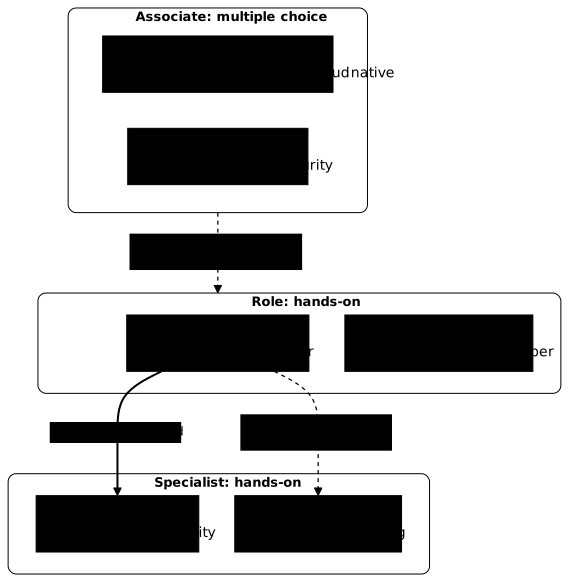
The diagram below shows three kinds of links between the exams. The dotted lines mean "recommended": the two Associate exams prepare you for the hands-on exams without being a mandatory gate. The solid line, from the CKA to the CKS, means "required". The dotted line from the CKA to the CKNE means "assumed": no exam prerequisite, but tasks that require you to read and repair a cluster by hand.
Skip the first two steps if you already have Kubernetes experience. And aim only for the CKA or only for the CKAD if your career goal is specific: nothing forces you to take them all.
The Kubestronaut path
The CNCF Kubestronaut program recognizes people who hold the following five certifications:
KCNA + KCSA + CKA + CKAD + CKS
All five certifications must be active at the same time to obtain the title, and it remains valid until the end of the year in which the first of the five expires (according to the Kubestronaut FAQ). The order of exams is free (except CKS after CKA).
Which certification for your profile?
The five tabs below describe paths, not rules. Open the one that matches your current job, not the one you are aiming for: you prepare a certification with what you already practice, and a developer who takes the CKA first spends a lot of time on kubeadm and etcd, topics they will rarely meet in their work. Each path also gives the logical next step once you have the first certification.
Beginner path
- Start with the KCNA: it structures your fundamental knowledge (multiple choice, no terminal)
- Practice on a local cluster: Minikube, Kind or K3s
- Then aim for the CKA or the CKAD depending on your orientation (admin or application)
The KCNA covers the Kubernetes fundamentals, container orchestration, cloud native application delivery and cloud native architecture. It prepares you without the stress of the command line.
Developer path
- Aim for the CKAD: the one most aligned with your application-side daily work
- Go deeper on Deployments: rolling updates, rollbacks, scaling
- Master configuration: ConfigMaps, Secrets, environment variables
- Practice the
kubectlshortcuts: speed makes the difference
After the CKAD, move on to the CKA if you are heading toward a DevOps/SRE role. If you are heading toward DevSecOps, add the KCSA, then take the CKA before the CKS, which requires it.
Ops / DevOps path
If your daily work is infra and operations:
- Aim for the CKA: installation, troubleshooting, cluster maintenance
- Focus on troubleshooting, 30% of the CKA exam
- Master
kubeadm: installation, upgrade, etcd backup - Understand networking: Services, DNS, Network Policies
If the cluster network is your main mission, the CKNE comes after the CKA: its preparation page says which objectives the course already covers.
If your daily work is rather application-side:
- Aim for the CKAD: deployment, configuration, application observability
- Then complete it with the CKA for the infrastructure part
After the CKA, the CKS is the natural next step if security interests you.
Security Engineer path
- KCSA first if you do not yet have a structured foundation in K8s security
- CKA is mandatory: it is the prerequisite for the CKS
- CKS, preferably soon after the CKA, while its topics are still fresh
- Go deeper on supply chain and runtime: the two big blocks of the CKS
One possible strategy is to prepare the CKA and the CKS in parallel, take the CKA, then take the CKS within the following 2-3 months.
Generalist path
- KCNA for the foundations (optional if you already have experience)
- CKA: the most complete on the platform side
- Complete it with the CKAD topics: Probes, init containers, rolling updates
- KCSA then CKS if security becomes a priority
The CKA covers part of the CKAD topics (Pods, Deployments, Services and ConfigMaps), but the CKAD goes further on application packaging, observability and exposing applications.
Where do CKAD, CKA and CKS overlap?
The three hands-on exams share common topics, but with different angles:
| Topic | CKAD | CKA | CKS | Quick reading |
|---|---|---|---|---|
| Pods / Deployments | ● | ◐ | ◐ | CKAD builds them, CKA operates them, CKS secures them |
| Services / networking | ● | ● | ◐ | Shared topic, different angle |
| ConfigMaps / Secrets | ● | ◐ | ● | CKAD consumes them, CKS protects them |
| RBAC / ServiceAccounts | ◐ | ◐ | ● | CKAD and CKA use them, security focus for CKS |
| Troubleshooting | ◐ | ● | ◐ | CKA clearly dominates (30% of the exam) |
| Storage (PV/PVC) | ◐ | ● | ○ | Mostly CKA |
| Probes / observability | ● | ◐ | ◐ | CKAD goes deeper |
| Network Policies | ◐ | ● | ● | CKA and CKS |
| Hardening / runtime | ○ | ○ | ● | CKS only |
| Supply chain | ○ | ○ | ● | CKS only |
Legend: ● Strong (major topic) | ◐ Medium (covered but not dominant) | ○ Weak or absent
What CKAD, CKA and CKS have in common
Whichever hands-on exam you take, you will need to:
- Master
kubectland the generation of YAML manifests - Know how to move quickly through the official documentation
- Diagnose problems within a time limit
- Work exclusively in the command line
How does this module prepare you for the exams?
Each certification has its own "Prepare for the..." page in the certifications module. It relies on the lessons of one level of the course: the KCNA on level 1, the CKAD on level 3, the CKA on level 4, the KCSA and the CKS on level 5. These lessons already cover the exam domains, and the preparation adds what they do not give you: pace, speed and practice in exam conditions.
The KCNA path is a multiple-choice exam, with no terminal, that structures the cloud native vocabulary, and it ends with a mock exam (in French). The CKAD and the CKA, the two hands-on role exams, each have a weekly program, a command cheat sheet and timed exercises.
The two security exams rely on level 5: the KCSA, theoretical, with its mock exam (in French), then the CKS, hands-on, which assumes the CKA has been passed. The KCSA appears right after the KCNA in this module, but its lessons are those of level 5: prepare for it once you have completed that level.
The CKNE preparation, a hands-on exam on networking, comes separately: it maps each domain to the existing lessons and says which objectives have no lesson. This order is the order of the course, not an obligation to take them that way: the section "Which order should you take them in?" above explains how to decide according to your profile.
CKA, Certified Kubernetes Administrator
The CKA validates your skills as a cluster administrator. You must know how to install, configure, maintain and troubleshoot a Kubernetes cluster in production.
CKA exam domains
| Domain | Weight | What is assessed |
|---|---|---|
| Cluster Architecture, Installation & Configuration | 25% | Components, kubeadm installation, upgrades |
| Workloads & Scheduling | 15% | Deployments, ConfigMaps, Secrets, scaling |
| Services & Networking | 20% | Services, Ingress, Network Policies, DNS |
| Storage | 10% | PV, PVC, StorageClass |
| Troubleshooting | 30% | Logs, events, fault diagnosis |
What the CKA is not
Drawing the boundary keeps you from studying topics that will not come up. Three confusions are possible when you discover the CNCF catalog, but the CKA stays centered on operating a cluster. Writing a Dockerfile, configuring Falco or defining an architecture term are not its subject.
- An application development certification is the role of the CKAD
- An in-depth security certification is the role of the CKS
- A theoretical exam on Kubernetes architecture is the role of the KCNA
CKA preparation path
The preparation follows the five domains of the exam. The heaviest, troubleshooting (30%), is practiced with the guide on debugging an application, which drills kubectl logs, describe and debug. The administration domains rely on the installation with kubeadm and the backup of etcd, both in Cluster Architecture (25%), on Services and Network Policies (Services & Networking, 20%), and on persistent volumes (Storage, 10%).
The CKA preparation hub maps each domain, Workloads & Scheduling included, to its lessons and gives the week-by-week program. The essential commands cheat sheet is for revising before the exam, where only the official documentation can be consulted, and the timed exercises reproduce the conditions of the exam.
CKAD, Certified Kubernetes Application Developer
The CKAD validates your skills as an application developer on Kubernetes. The goal: know how to package, deploy and configure your applications so that they run properly on K8s.
CKAD exam domains
| Domain | Weight | What is assessed |
|---|---|---|
| Application Design and Build | 20% | Dockerfiles, multi-container Pods, init containers |
| Application Deployment | 20% | Deployments, rolling updates, Helm |
| Application Observability and Maintenance | 15% | Probes, logs, debugging |
| Application Environment, Configuration and Security | 25% | ConfigMaps, Secrets, ServiceAccounts, authorization (RBAC), SecurityContext, resources |
| Services & Networking | 20% | Services, Ingress, Network Policies |
What the CKAD is not
The CKAD stops at the edge of the cluster: you consume the platform, you do not administer it. Joining a node to the cluster, restoring etcd or analyzing the kube-apiserver logs are administration tasks, and therefore more the CKA's. On the other hand, execution speed matters as much as on the CKA: 15 to 20 tasks share the 2 hours.
- A cluster installation certification is the role of the CKA
- A hardening or advanced security certification is the role of the CKS
- An exam on the internal architecture of Kubernetes
CKAD preparation path
The preparation follows the life cycle of an application. The heaviest domain is Application Environment, Configuration and Security, at 25%: it concentrates ConfigMaps, Secrets, ServiceAccounts, RBAC, SecurityContext and resources, and deserves the matching amount of time. The rest runs from Deployments and their rolling updates and rollbacks to probes, then to Services and Ingress.
The CKAD preparation hub maps each domain to its lessons. Since the CKAD rewards speed, the essential commands cheat sheet is your support, and the timed exercises train you to chain short tasks.
CKS, Certified Kubernetes Security Specialist
The CKS is the advanced security certification. It assumes you already master Kubernetes administration (CKA) and asks you to secure the build, the deployment and the runtime of workloads.
CKS exam domains
The CKS is the only hands-on exam split into six domains, and the distribution is remarkably flat: five domains weigh 15 to 20% each, none dominates the way troubleshooting does on the CKA. In practice, no domain can be sacrificed without risk. The last three domains total 60% and fall outside an administrator's usual scope: workload security, supply chain and runtime security are the blocks that the CKA does not prepare, and therefore the ones that demand the most extra work.
| Domain | Weight | What is assessed |
|---|---|---|
| Cluster Setup | 15% | Network Policies, CIS benchmarks, secure Ingress |
| Cluster Hardening | 15% | RBAC, Service Accounts, API restriction |
| System Hardening | 10% | OS hardening, attack surface reduction |
| Minimize Microservice Vulnerabilities | 20% | SecurityContext, Pod Security, secrets |
| Supply Chain Security | 20% | Image scanning, signing, admission controllers |
| Monitoring, Logging & Runtime Security | 20% | Audit logs, anomaly detection, Falco |
What the CKS is not
- A first Kubernetes certification (CKA required)
- A "CKA with a few security questions"
- A theoretical exam on security concepts, that is the role of the KCSA
The CKS does not test your ability to administer Kubernetes from scratch. It assumes this foundation and assesses you only on security.
CKS preparation path
The plan runs over eight weeks: weeks 1 and 2 for Cluster Hardening and Cluster Setup, weeks 3 and 4 for Minimize Microservice Vulnerabilities and System Hardening, weeks 5 and 6 for Supply Chain Security, week 7 for Monitoring, Logging and Runtime Security, and week 8 for review and simulation. It follows the order in which cluster security is built: you first set up identity, network and Pod limits with RBAC, Network Policies and the Pod Security Standards, then you check those rules with the CIS Benchmark. Next come Supply Chain Security, the Admission Controllers (in French), which reject what is not compliant, then the audit logs and Falco.
The CKS preparation hub details each block and its lessons, and the overview Securing Kubernetes (in French) ties it all together. The essential commands cheat sheet is for revising before the exam, where only the official documentation can be consulted, and the timed exercises finish the preparation, with a hands-on mock exam of 16 tasks in 120 minutes.
CKNE, Certified Kubernetes Network Engineer
The CKNE validates your skills on the network of a Kubernetes cluster: installing and diagnosing a CNI plugin, configuring Services and DNS, exposing traffic with the Gateway API, applying network policies and observing traffic. It was launched by the CNCF on November 10, 2026.
CKNE exam domains
Two domains weigh 25% each, which is half of the blueprint. The weights come from the official blueprint, retrieved on November 14, 2026.
| Domain | Weight | What is assessed |
|---|---|---|
| Core Infrastructure and CNI | 15% | CNI plugins, IPAM, Linux tools, Pod connectivity |
| Service Networking and DNS | 25% | L4 Services, kube-proxy, CoreDNS, endpoints, Gateway API |
| Advanced Traffic Management | 20% | LLM traffic, routing, egress gateways, multi-cluster |
| Network Security and Policy | 25% | NetworkPolicies, encryption, Gateway TLS, authentication between Pods |
| Observability | 15% | Metrics, tracing, traffic logs |
What the CKNE is not
It is not a general security certification, that is the role of the CKS, nor a cluster administration exam, that is the role of the CKA. It does not cover application development, the domain of the CKAD.
CKNE preparation path
The course currently prepares 14 of the 22 objectives, 5 of them in part, as of November 14, 2026. The Advanced Traffic Management domain has no lesson. The page Prepare for the CKNE maps each domain to its lessons, says which objectives have no lesson and proposes a preparation order.
Preparation tips (CKA, CKAD, CKS)
The following tips apply to the three hands-on exams CKA, CKAD and CKS; the CKNE, also hands-on, has its preparation page. For the Associate certifications, see the preparation hubs for the KCNA and the KCSA.
Preparation phase
- Practice daily: 30 minutes a day beats 4 hours on the weekend
- Use a local cluster: Minikube, Kind or K3s to experiment
- Follow the guides in this course: they cover the exam domains
- Time yourself: the exam is short, speed matters
Three resources complement these guides:
- Killer.sh, an exam simulator whose access depends on your offer: it is included in CKA, CKAD and CKS registrations, but not in the "exam only" offers (CKA-SINGLE, CKAD-SINGLE, CKS-SINGLE). The CKNE product page mentions it too: check in every case what your offer contains
- KodeKloud, interactive labs
- Graded Kubernetes labs on GitHub, to be played with the
dsoxlabCLI
During the exam
These five reflexes share one goal: not losing points on tasks you know how to do. A task solved in the wrong namespace or with an approximate object name may not be found where the automatic grading looks for it, even if the manipulation is correct. The third point takes discipline under pressure: sticking with one of them for too long costs you the next two.
- Read the task carefully: every word counts (namespace, exact name, labels)
- Use the official docs: you have access to them, copy the YAML
- Do not get stuck: skip and come back later
- Check your answers: a quick
kubectl getto confirm - Manage your time: keep 10-15 minutes to review
Essential commands
These few lines replace writing YAML by hand, which costs too much time in the exam. The pattern to automate is --dry-run=client -o yaml: it produces a valid manifest that you then edit, instead of starting from a blank page. The kubectl explain command is also worth knowing: it gives the exact name of a field without leaving the terminal for the documentation. The images carry their @sha256:… digest; on exam day, type the image the way the task gives it, without a digest.
The last two lines of the block are your own setup. On the task hosts of the CKA, CKAD and CKS exams, the k alias and completion are already defined (official CKA and CKAD tips, official CKS instructions): the alias is therefore for practicing at home. The $do variable is the one worth typing in the very first minute, then after each ssh connection, since it saves a lot of keystrokes over two hours.
# Quick manifest generationkubectl run nginx --image=nginx:1.30.5@sha256:9bf97bd7714f5e24c1ccd545ecb9eb5435cb6d109c97cebb15e7e455e0239edb --dry-run=client -o yaml > pod.yamlkubectl create deployment nginx --image=nginx:1.30.5@sha256:9bf97bd7714f5e24c1ccd545ecb9eb5435cb6d109c97cebb15e7e455e0239edb --dry-run=client -o yaml
# Exploring the APIkubectl explain pod.spec.containerskubectl explain deployment.spec.strategy
# Exposing services (adapt the type to the task)kubectl expose deployment nginx --port=80
# Aliases (the exam hosts already define k)alias k=kubectlexport do="--dry-run=client -o yaml"
Results and next steps
You receive your results by email after the exam; the exact delay is given in the Linux Foundation FAQ.
If you pass, you get a certification valid for 2 years.
If you fail, a retake is included. First analyze your weak points in the score report, then redo timed exercises, and the Killer.sh simulator sessions if your offer includes them, before trying again.
Which certifications does the CNCF announce for 2027?
The CNCF announces two new certifications for 2027: the KAIA (Kubernetes AI Associate) and the CKIE (Certified Kubernetes Inference Engineer). It named them on November 10, 2026, when it launched the CKNE: "Looking ahead, CNCF also plans to introduce two additional certifications in 2027: Kubernetes AI Associate (KAIA) and Certified Kubernetes Inference Engineer (CKIE)." It adds: "These upcoming credentials will further expand CNCF's training and certification portfolio as AI and cloud native technologies continue to converge."
As of November 14, 2026, no curriculum, no price, no format and no exact date are published for either of them. They are therefore absent from the comparison above, which only compares exams that are available. One page per certification says what is official and what is not: the KAIA and the CKIE.
Key takeaways
This table sums up, in one line per question, the choices made on this page: the certification to aim for, the exam format and the rules that apply to all of them.
| Question | Answer |
|---|---|
| I am discovering Kubernetes? | KCNA (multiple choice, fundamentals, 90 min) |
| I want a security foundation? | KCSA (multiple choice, security fundamentals, 90 min) |
| Application developer? | CKAD (hands-on, 2h) |
| Admin / SRE / DevOps? | CKA (hands-on, 2h) |
| Advanced security? | CKA then CKS (hands-on, 2h) |
| Cluster network? | CKA then CKNE (hands-on, 2h) |
| Validity? | 2 years for the 6 certifications earned today |
| Only exam prerequisite? | CKS requires CKA (the CKNE assumes CKA level without requiring it) |
| Multiple-choice format? | KCNA, KCSA |
| Hands-on format (CLI)? | CKA, CKAD, CKS, CKNE |
| Kubestronaut? | KCNA + KCSA + CKA + CKAD + CKS (all 5 active at the same time) |
| What about the KAIA and the CKIE? | Announced for 2027, with no curriculum or price published |
Official CNCF links
Prices, durations and above all the exam curricula change: the CNCF regularly publishes a new curriculum version for each hands-on certification, aligned with Kubernetes versions. Check the matching official page right before you register, it is the only source that is authoritative on the domain weights and on the Kubernetes version used in the exam environment.
- KCNA, Kubernetes and Cloud Native Associate
- KCSA, Kubernetes and Cloud Native Security Associate
- CKA, Certified Kubernetes Administrator
- CKAD, Certified Kubernetes Application Developer
- CKS, Certified Kubernetes Security Specialist
- CKNE, Certified Kubernetes Network Engineer and its blueprint
- Kubestronaut program
- CNCF certification program