A hosting platform is a place that the company provides to host the applications its business teams create with AI, instead of letting them run on a workstation or a personal account. It reads as a series of five zones separated by boundaries: the place where you create, the one where you check, the one where you decide, the one where the application runs, and the information system it wants to reach. This page is written for decision makers and beginners, with no technical prerequisite. It gives the overall plan of the platform: its zones, its boundaries and its decision makers.
What you will learn
- Describe what a hosting platform is and why it replaces shadow AI.
- Read a trust boundary diagram and follow the path of an application.
- Name the five zones and what each one controls.
- Tell the sandbox apart from production.
- Explain why separating two applications takes more than a group name.
- Know who decides on the platform, and why the requester never decides on their own request.
What is a hosting platform, and why do you need one?
A hosting platform is the place where the company agrees to host an application created by a business team, provided it has passed controls. It answers the situation described in the page Shadow AI: if the company offers no safe place, applications are born elsewhere, with nobody checking them.
The thread running through the training is the purchasing portal, a case invented for teaching. A buyer used a coding assistant to create an application that reads the orders of an ERP, the company's management software. On the hosting platform, this application does not talk directly to the ERP, does not receive a secret in clear text and does not start without approval: a technical owner in C2, an authorised person from C3 onward. The page Risks of AI-generated applications describes the five causes of incident that these rules stop.
To fix ideas, this page names specific tools, for example Forgejo to host the code and k3s for the cluster. They are examples: other tools play the same roles, and what matters here is the shape of the plan, not the choice of products.
What is a trust boundary?
A trust boundary separates two zones that do not have the same level of trust: what crosses it must be verified, limited and traced. Verified means knowing who sends the request. Limited means bounding what it can do. Traced means keeping a record of what it did.
A flow that stays inside a zone whose components trust each other needs little attention. A flow that crosses a boundary needs much more. For a decision maker, reading an architecture therefore comes down to spotting where the boundaries run and asking these three things at each crossing. The lesson Trust boundaries and STRIDE on a Kubernetes cluster applies the same idea inside a cluster, with a threat analysis method. This page applies it to the whole platform.
How do you read the hosting platform diagram?
The diagram shows the path of an application, from creation to access to the information system. Each frame is a zone. Follow the thick arrows: they represent the main path of the code, from the candidate repository to the API gateway. The thin arrows show what is added along the way: from class C3, the signature of the artifact and the decision of an authorised risk owner; in C2, the technical owner's recorded approval. The red node, at the bottom, is an access that the platform refuses: the application never connects directly to the ERP database.
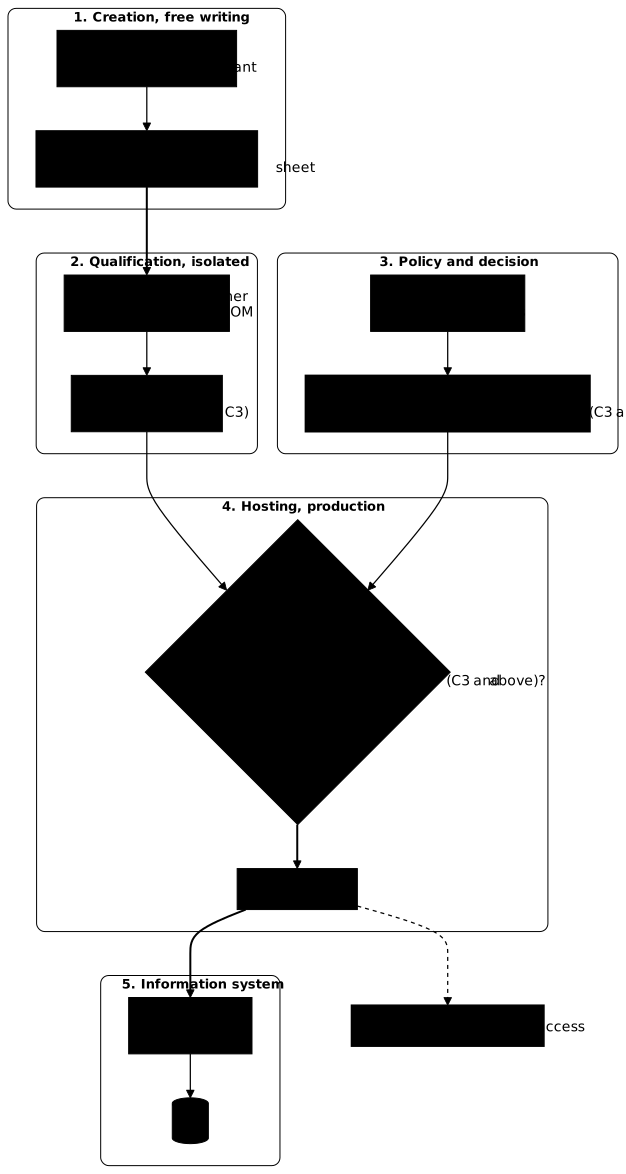
Three boundaries can be read on this diagram. Between zones 1 and 2, the candidate's code enters a control environment and is never taken on trust. Between zones 2 and 4, only an artifact accompanied by a decision passes: from C3, a signed artifact and the decision of an authorised risk owner; in C2, the technical owner's recorded approval. Between zones 4 and 5, everything goes through the gateway, which checks identity and rights on each call.
What are the five zones and what does each one control?
Each zone has a role and an entry rule, and none does the work of its neighbour. The same building block never holds two roles: whoever writes does not check, and whoever checks does not decide.
The creation zone is the only one where the author writes freely. They work there with their assistant and drop their code into a candidate repository, managed by a forge, that is, the platform that hosts code repositories and their reviews (see What is a Git forge and which one should you run? (in French)). They attach a sheet that describes the application: what it is for, what data it handles, who owns it. This sheet is a request, never an authorisation.
The qualification zone runs the automatic checks. A CI runner, a program that executes the checks requested by the forge, is thrown away there after each task, which limits what booby-trapped code can leave behind. It looks for secrets, flaws and dubious dependencies, draws up the inventory of components (SBOM) and produces an artifact, that is, the packaged application, which is signed from C3. The page Forgejo: run the CI runner securely (in French) details the runner, and Cosign the signature.
The policy and decision zone is deliberately separate. It contains the class retained for the application and the authorisation decision, signed by an authorised risk owner from C3 (in C2, the technical owner's approval). The candidate repository cannot modify it: otherwise the author would authorise themselves. The lesson Classify an application before hosting it explains how the class is computed.
The hosting zone runs the application on a dedicated Kubernetes cluster, that is, a group of machines managed together by the Kubernetes software to run applications. An admission controller, that is, a guard placed at the entrance of the cluster, applies the rules of the application's class before letting it start: from class C3, it refuses anything that is not signed or that has no valid decision (Admission controllers (in French), Kyverno). The guide K3s (in French) presents k3s, a lightweight Kubernetes distribution.
The information system zone groups what the application wants to reach. An API gateway, a single entry point in front of the ERP, authenticates each call and applies rights per operation, with a single sign-on service (SSO, see Keycloak and The basics of IAM (in French)). It complements the authorisation control described in the page on risks, but it does not replace it: it does not know that order 4813 belongs to another buyer. The application must therefore check itself, object by object, that the user has the right to read it, and the team tests it with a second account.
What is the difference between the sandbox and production?
The sandbox is a trial place that cannot break anything or read anything important; production is where the application serves real people with real data. A sandbox is an isolated space where you try things with no effect on the rest. It only receives fictitious data and has no access to the information system.
In the diagram, the creation zone and the qualification zone belong to the sandbox, and the hosting zone belongs to production. The move from one to the other is the most important decision of the whole chain, and its requirements depend on the application's class. In class C2, it requires the technical owner's recorded approval and a peer review before the merge. From class C3, it requires a signed artifact and the decision of an authorised risk owner. An application that stays experimental needs none of this. This rule is found in the grid of the lesson Classify an application: the lowest class, C1, is not deployed on the platform.
Do not confuse this sandbox with that of a coding agent, which confines what the assistant can run on its user's workstation. The guide Code execution sandbox for AI agents (in French) covers this second subject, which belongs to the developer's way of working.
Why is a namespace not enough as a boundary?
A Kubernetes namespace groups resources under a name, but on its own it does not solidly isolate one application from another. Two applications in two namespaces of the same cluster run on the same machines. By default, each application runs in a container, an isolated envelope, and Kubernetes launches this container in a unit called a pod. Any pod can reach all the others.
Only network rules, the NetworkPolicy objects, forbid these exchanges. They must be declared, then enforced by the cluster's network plugin. Without them, a compromised application can reach the others over the network.
For a strong separation, you separate machines, networks and identities, then you test the traffic that is really blocked instead of reading the configuration. A firewall rule that does nothing still reads like an active rule. The lesson Trust boundaries and STRIDE details the internal boundaries of a cluster, and Pod Security Standards describes the level of constraints imposed on each pod.
Who decides what on this platform?
Operations run automatically, but only an authorised human can accept a risk or allow a flow toward the information system. The requester can never be the approver of their own request.
Five roles are involved. The business requester is the person who created or had the application created. The platform is the team that runs it. The CISO, the chief information security officer, decides on the application's class. The DPO, the data protection officer, advises on the GDPR. The authorised risk owner is the person to whom management has delegated, in writing, the power to accept a risk for a given scope and duration: they accept the residual risk and allow a flow toward the information system.
The platform executes and proves; it does not decide. This split is the one used in the training's exercises, and a real company adjusts it. The lesson Governance details it activity by activity, with the rule that forbids the requester from approving their own request.
How can you check that you understood?
Follow the purchasing portal on the diagram and name every boundary it crosses. For each one, answer the three questions from earlier: who sends the request, what can it do, who keeps the record. If an answer is missing, you have found a control to ask for.
A second exercise consists of removing a zone and saying what becomes possible. Without the policy zone, the author authorises themselves. Without the gateway, the application reads the database directly. Without qualification, the invented package is installed without anyone seeing it.
Key takeaways
- A hosting platform gives business teams a safe place, instead of leaving them to create in the shadows.
- It reads as five zones: creation, qualification, policy and decision, hosting, information system.
- What crosses a trust boundary is verified, limited and traced.
- Whoever writes does not check, whoever checks does not decide, and only an authorised risk owner accepts a risk.
- The authorisation decision lives outside the candidate repository, otherwise the author would authorise themselves.
- The sandbox is for trying things without risk; to move to production, the requirements rise with the class: technical owner approval and peer review in C2, signed artifact and decision of an authorised risk owner from C3.
- A namespace is not enough as a boundary: you separate machines, networks and identities, and you test what is blocked.
- The application reaches the information system only through a gateway that checks identity and rights, and it checks access to each object itself.
Knowledge check
These eight questions cover the five zones of the hosting platform, the trust boundaries and the move from the sandbox to production.
Knowledge check
Check what you have learned with this interactive quiz
How it works
- The timer starts when you click Start
- Multiple choice, true/false and short answer questions
- You can move between questions
- Detailed results are shown at the end
Starts the quiz and the timer
Review
(0/0)Score by domain
A domain groups several guides and gets several questions, so its score is more reliable than a per-topic score, which often rests on a single question.
Summary
Strengths
No topic passed at 80% on at least two questions yet.
Weak areas
No topic below the pass mark.
Recommended next
Hints before you try again?
Continue the course: Classify an application before hosting it: the C1 to C4 grid
A new full quiz with random questions
Work again only on the questions you missed