Vibe coding means describing in plain language what you want and letting an AI write the code. In the strict sense, the one given by Andrej Karpathy (February 2, 2025) and Simon Willison (March 19, 2025), you accept the result without reading it, and that is the sense that carries the risk. In everyday use the term is broader: building software by telling an AI what you want. This page defines both senses, explains what vibe coding changes for developers, business teams and the company, lays out the measured risks, summarises what the European AI regulation (the AI Act) really requires and gives the best practices that make AI usable in production. It is written for developers, technical managers and people from a business team who are discovering the subject.
What you will learn
- Tell vibe coding, in the strict sense, apart from AI-assisted development, using a single criterion: reviewing the code before accepting it.
- Describe what vibe coding changes for a developer, for a business employee and for the company.
- Recognise two measured risks: insecure generated code and the invented dependency known as slopsquatting.
- Say what the AI Act does and does not require from a company that uses a coding assistant.
- Apply five gestures that keep a human accountable for what goes to production.
- Explain why reviewing an agent's changes and checking the dependencies it proposes are the two controls that matter most.
What is vibe coding?
Vibe coding is a way of programming where you no longer read the code the AI produces. The term comes from Andrej Karpathy, co-founder of OpenAI and former head of AI at Tesla. In a post published on X on February 2, 2025, he describes a way of coding where you let the AI carry you: "fully give in to the vibes, embrace exponentials, and forget that the code even exists". He adds: "I "Accept All" always, I don't read the diffs anymore". In other words, he accepts every change the tool proposes and no longer reads the diffs. The post was picked up by Simon Willison on February 6, 2025.
Karpathy specifies that this method suits "throwaway weekend projects", small projects you discard afterwards. He does not present it as a production method. The vibe coder is therefore the person who describes, runs, checks whether it works and starts over, without caring what the code contains. The term has since taken a broader meaning: building software by describing in natural language what you want to an AI, whether or not the code is reviewed. This page keeps both senses and tells them apart, because the risk is not the same.
What is the difference between vibe coding and AI-assisted development?
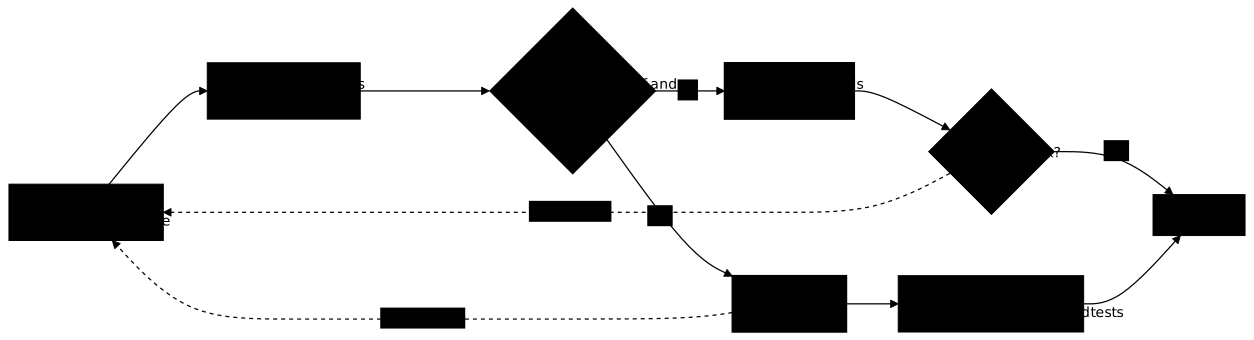
The criterion that changes the risk is reviewing the code before accepting it. In vibe coding, you accept what the AI proposes without reading the diff, the list of added and removed lines, and you rely only on how the application behaves. In AI-assisted development, the person reads every change, runs tests and can refuse or fix the result before it enters the repository, the place where the project keeps its code. The code comes from the AI in both cases, but only the second case leaves a human accountable for what goes to production.
The diagram below places this decision in the complete cycle, from the request to the deployment. Look at the diamond: before it, the request and the generation are identical in both practices. On the "no" answer, you only judge whether the code works: if it does not, you start again with a new request, and if it does, the unreviewed code is deployed. On the "yes" answer, the code goes through review and tests, which send you back to the request when a defect appears.
Simon Willison, a developer and author, reserves the name vibe coding for the strict sense. In his post Not all AI-assisted programming is vibe coding (but vibe coding rocks), published on March 19, 2025, he writes: "When I talk about vibe coding I mean building software with an LLM without reviewing the code it writes." For him, if you review the code, test it and can explain it, "that's not vibe coding, it's software development". In everyday use the word is broader, but review remains what raises or lowers the risk: without it, the risk rises sharply. In a company, this criterion is used to decide which usage is allowed for which type of project.
What does vibe coding change, and for whom?
Vibe coding lowers the cost of a first prototype and makes building an application accessible to people who do not write code. The effects differ by profile, and the risk does not sit in the same place.
A developer saves time on repetitive code and first drafts, but remains the one who judges whether the result is correct. A citizen developer, that is, an employee from a business function (finance, HR, logistics) who builds a tool without developer training, gets an application that works without understanding what it contains. A company sees applications appear that nobody declared to the IT department, whose data, access and maintenance escape any control.
The skill shifts: you write less syntax, but you describe the intent precisely, and you review and test more. The risk therefore grows with the distance between the person who generates and the person who answers for the result. The post Your time saved must not become our technical debt details the case of taking these applications over in production.
What are the risks of vibe coding for a company?
Code accepted without review enters production with every defect nobody saw. Six risks are worth knowing: flaws in the code, invented dependencies, secrets sent in prompts (the written instructions you give the AI), missing access controls, undeclared applications and the departure of the author. The first two have been measured in published studies; the others are mostly seen in field reports and do not rest on a figure here.
Does AI-generated code contain security flaws?
Yes, in a proportion measured by at least one study. In July 2025, Veracode, an application security vendor, published its GenAI Code Security Report. The study gave more than 100 models 80 programming tasks and found insecure code in about 45% of cases. An update dated March 24, 2026 gives a similar result, about 45%, across four languages and four categories of weakness (SQL injection, cross-site scripting, log injection and weak cryptographic algorithms, that is, entries CWE-89, 80, 117 and 327 of the software weakness catalogue). In this update, code generated without a security instruction passes the syntax check in more than 95% of cases.
These figures come from a security vendor, measured by its own static analysis tool (a program that reads code without running it), on selected tasks. They give an order of magnitude and not the flaw rate of your application. Code that runs is not necessarily secure code.
What is slopsquatting, or dependencies invented by the AI?
A coding assistant can suggest installing a package that does not exist. A package, or dependency, is a piece of code published by a third party that the application downloads, for example from npm for JavaScript or PyPI for Python. Slopsquatting means publishing a malicious package under a name that models often invent. The term is formed by analogy with typosquatting, which exploits typing mistakes. Without a review of the dependency file, the vibe coder installs this package without knowing it.
Researchers have measured the phenomenon: Spracklen and his co-authors tested 16 models on 576,000 code samples in their study We Have a Package for You!, presented at USENIX Security in 2025. They found 205,474 invented package names, with at least 5.2% of non-existent packages for commercial models and 21.7% for open models. The guide securing npm, PyPI and Go dependencies explains how to check and pin what you install.
What other risks does vibe coding bring?
Four more risks affect the organisation more than the code. The page Risks of AI-generated applications takes them up as five causes of a single incident: the invented dependency, the secret pasted into a prompt, the rights over the code, the object-level authorisation flaw and the author's departure. The flaws of the generated code are treated there as a cross-cutting risk, and undeclared applications are covered by the page Shadow AI.
Secrets and data end up in prompts: an employee who pastes a database extract or an access key into the tool sends that information to an external service. If the extract contains personal data, sending it is a processing of data within the meaning of the GDPR, Regulation (EU) 2016/679, for which the company is accountable. Authorisation checks are easily forgotten, because an application that shows the right data to its author has not been tested with another account. Undeclared applications, known as shadow AI, escape the inventory, the backups and the updates. Finally, when the business author leaves the company, nobody knows any more how the application works or how to fix it.
The SOCLE reference on AI (in French) on this site details the inventory of uses and the review of AI outputs. Applications that themselves rely on a large language model (LLM) have their own flaws, detailed in the guide securing an LLM application (in French). Finally, a generated application placed on the market as a product with digital elements, that is, software together with its remote data processing solutions, may fall under Regulation (EU) 2024/2847 on cyber resilience. Software written for purely internal use, never supplied to third parties, is in principle not placed on the market. The reporting obligations apply from September 11, 2026, the others from December 11, 2027. The page Cyber Resilience Act (in French) explains the resulting obligations for its publisher.
What does the AI Act say about vibe coding?
The AI Act, the European regulation on artificial intelligence (Regulation (EU) 2024/1689), does not require a company that uses a coding assistant to document its prompts or to trace every generation. The documentation and transparency obligations target providers of high-risk AI systems and providers of general-purpose models, that is, the publishers of large AI models. For a simple coding assistant, the user company is mainly concerned by Article 4, which deals with AI literacy: it must take measures to support the development of this literacy among its staff, without having to guarantee a specific level for each person. Companies that deploy a high-risk AI system have other obligations (Article 26), and Article 50 imposes transparency obligations on certain deployers (paragraphs 3 and 4).
This wording of Article 4 and the current timetable come from Regulation (EU) 2026/1744, called the "AI omnibus", adopted on July 8, 2026, published in the Official Journal on July 24, 2026 and in force since July 27, 2026 (text on EUR-Lex). The rules for high-risk systems in Annex III apply from December 2, 2027, those of Annex I from August 2, 2028.
If the generated application is itself an AI system used in a high-risk case, the situation changes: have your legal department validate the case.
What are the best practices for coding with AI in a company?
The practices below are recommendations from this site, not a standard. They describe how to vibe code with a method: keep a human accountable for what goes to production, at every step of the cycle shown above.
- Write what the application must do, with its error cases and its access rules, before launching the AI. The guide plan mode and diff validation (in French) shows how to have a plan proposed before any change.
- Have the AI write the test before the code, read it and check that it fails, and only then ask for the code: a test nobody has read can validate a wrong behaviour.
- Read the diff before accepting, as you would for a colleague's contribution.
- Keep control of dependencies and secrets: check every added package and never paste an access key into a prompt. See securing dependencies.
- Frame the agent, the AI that reads the repository, edits files and runs commands, with a harness, that is, the set of limits around it: project instructions in CLAUDE.md (in French), permissions (in French), hooks (in French) that block an action before it runs, and a sandbox (in French) that confines the commands.
These five gestures do not replace a security review of an exposed application. The guide securing Claude Code (in French) chooses the defence to put in place according to the threat, and the guide code execution sandbox for AI agents (in French) shows how to isolate generated code when the agent runs it itself.
Which tools can you use for vibe coding?
Tools fall into three families, which differ by where the AI steps in and by how much work it does without asking you. Any family can serve vibe coding as well as assisted development: it is your decision to review, not the tool, that makes the difference.
Command-line agents read the repository, edit files and run commands in a terminal, like Claude Code (in French). Editor-integrated assistants, such as GitHub Copilot in VS Code (in French) or Cursor, complete and generate code inside the editor. Online application builders produce a complete application from a browser, without going through a code editor.
The capabilities, model names and prices of these tools change often: check their official documentation before choosing. To understand what an agent really does, the AI overview lays the groundwork (LLMs, agents, tool calling).
Which training prepares you to secure AI-generated applications?
This site offers the training "Secure and govern AI-generated applications", whose home page is AI-generated applications. It targets three audiences: people who must decide and supervise what can go to production, those who build and run these applications, and those who want to vibe code with a method. This page is its entry point: it sets the vocabulary and the risks that the training works on. The lesson Shadow AI explains how these applications are born outside any control, and the lesson Risks of AI-generated applications follows a single case down to its five causes of incident.
Where can you learn to review an agent and check its dependencies?
This page sets the vocabulary and the risks. The two controls that matter most when facing a coding agent each have their own lesson, on the fictional purchasing portal: The working loop with a coding agent: specify, test, review, then Checking a dependency proposed by an AI before installing it.
Key takeaways
- In the strict sense, vibe coding means AI-generated code accepted without review, a term proposed by Andrej Karpathy on February 2, 2025 for disposable projects; in everyday use, it covers any software creation by describing what you want to an AI.
- Reviewing the code before accepting it is the risk criterion: without it, the risk rises sharply; with it, we speak of AI-assisted development (Willison, March 19, 2025).
- Veracode found insecure code in about 45% of the tasks tested in 2025 and in 2026: a vendor study, to be read as an order of magnitude.
- Models invent package names (at least 5.2% for commercial models in the USENIX Security 2025 study), which slopsquatting exploits: check every dependency.
- The AI Act does not require the user company to document prompts; its Article 4 targets AI literacy among staff.
- Specify, test, read the diff, control dependencies and secrets, frame the agent: these are recommendations for vibe coding with a method and keeping a human accountable.
Knowledge check
These eight questions cover the definition of vibe coding, the review criterion, invented dependencies, the figures cited and best practices.
Knowledge check
Check what you have learned with this interactive quiz
How it works
- The timer starts when you click Start
- Multiple choice, true/false and short answer questions
- You can move between questions
- Detailed results are shown at the end
Starts the quiz and the timer
Review
(0/0)Score by domain
A domain groups several guides and gets several questions, so its score is more reliable than a per-topic score, which often rests on a single question.
Summary
Strengths
No topic passed at 80% on at least two questions yet.
Weak areas
No topic below the pass mark.
Recommended next
Hints before you try again?
Continue the course: Shadow AI: definition, risks and how to supervise it
A new full quiz with random questions
Work again only on the questions you missed