Governing AI-generated applications means deciding in advance who says yes, who says no, and on what evidence, so that a business team receives neither a refusal on principle nor an authorisation granted by default. This page is for decision-makers (IT department, security manager, business manager) and beginners, with no technical prerequisite. It compares ban, supervision and hosting on an internal platform, splits the decisions between the roles, explains why a requester never approves their own request, then lists the useful evidence and indicators.
What you will learn
- Choose between banning, supervising and hosting, according to the class of the application.
- Split the decisions between the business, the platform, the CISO, the DPO and the authorised risk owner.
- Explain why the requester cannot approve their own request.
- List the evidence to require before accepting an application.
- Choose indicators that measure an outcome rather than an activity.
Ban, supervise or host: how do you choose?
You do not choose one stance for the whole company: you choose it by class of application. The lesson Shadow AI presented the three options and their effects: banning makes the usage invisible, supervising takes training and follow-up, hosting on a platform costs effort to set up but brings the usages out of the shadows. What remains is to say which option goes with which application.
The simplest way is to rely on the class of the application, from C1 to C4. The lesson Classify an application details the calculation: the application gets a score from 0 to 3 on four criteria (data, flows to the information system, users, business criticality) and the highest score sets the class. Each class calls for a different stance.
| Class | Example | Stance | What is asked |
|---|---|---|---|
| C1 | Prototype that the author opens alone, with no real data | Supervise with a simple rule | Fictitious data, no deployment on the platform, no authorisation |
| C2 | Team tool with internal data, no flow to the IS | Host | Automatic controls, business and technical owners named, peer review before merge, recorded validation by the technical owner |
| C3 | Company application that reads the ERP or processes personal data | Host, with a decision | A decision sheet signed by an authorised risk owner other than the requester |
| C4 | External application, which writes into the IS or processes sensitive data | Host, with a double decision | Two signed sheets: that of the manager of the requesting department, other than the requester, and that of the CISO or their delegate, who signs as the authorised risk owner |
The table reads from top to bottom: the higher the class, the heavier the human decision weighs. A ban remains useful for a specific case, such as pasting a secret or health data into an unvalidated external service. It does not work as a general policy, because an employee who has found a time saving keeps it, out of the security team's reach.
The thresholds of this table are those of this course. They are not those of a standard: an organisation adapts them to its context, its data and its legal framework (see the legal framework).
What rules does each class impose?
A class sets an authorisation period, and an authorisation expires. It does not stay valid "until further notice". At expiry, the application is requalified: its data, flows and users may have changed, and its class with them. The maximum period drops as the class goes up: 12 months at most in C2, 6 months in C3, 3 months in C4, and none in C1, which is not deployed. The table of the lesson Classify an application gives, for each class, the controls, review and signatures that go with this period.
Two rules complete the grid. When in doubt about a criterion, you keep the higher score: doubting costs one more control, not one more risk. A class can always be raised; it is lowered only by a written decision of the CISO, who decides the class (see the RACI grid below). This decision never goes below the class the grid calculates: only a doubt resolved on a criterion can bring a class raised out of caution back to the calculated class.
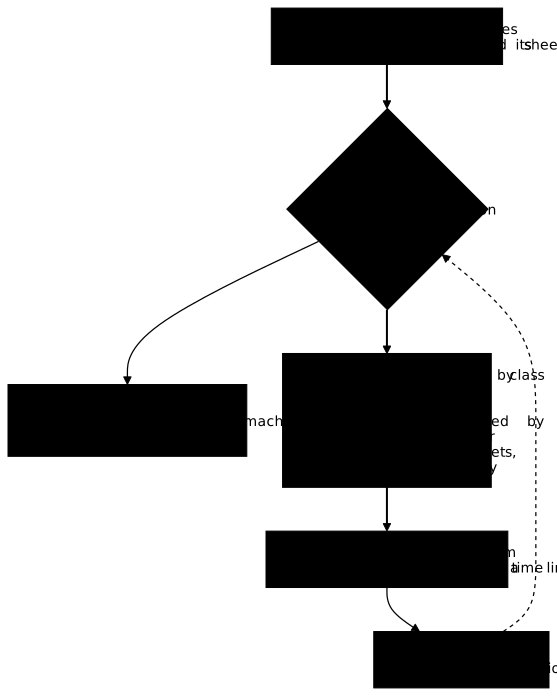
The following diagram shows the path: follow the thick arrow from the declaration to the class, then the control specific to each class. The dotted return arrow is a reminder that the authorisation expires.
Who decides what?
Each decision has a single final owner, and it is never the requester for their own request. The RACI grid, explained in Shared responsibility, notes for each activity who carries it out (R), who decides and answers for the result (A), who is consulted (C) and who is informed (I). There is never more than one A per line, and a line that decides nothing, like the declaration, carries none.
Five roles are involved. The business requester is the person who built or had built the application. The platform is the team that runs the hosting platform. The CISO is the person in charge of information security. The DPO, data protection officer, oversees the application of the GDPR. The authorised risk owner is the person to whom management has delegated, in writing, the power to accept a risk for a given scope and period.
| Activity | Requester | Platform | CISO | DPO | Authorised risk owner |
|---|---|---|---|---|---|
| Declare the application and its sheet | R | C | I | C | I |
| Classify the application and choose the path | C | R | A | C | I |
| Carry out the DPIA when mandatory | R | C | C | C | A |
| Accept the residual risk or a waiver | C | C | C | C | A |
| Authorise a flow to the IS | C | R | C | C | A |
| Revoke an access or quarantine | I | R | A | I | I |
Read one line at a time. The requester declares, but does not classify: the CISO decides the class. For the DPIA, the GDPR gives the decision to the controller (Article 35), that is, the company, which acts here through its authorised risk owner. The DPO is consulted: it advises and checks the execution of the assessment (Article 39). The authorised risk owner also accepts the risk and authorises a flow to the IS. The CISO can revoke an access without waiting for a committee, because cutting fast protects more than discussing for long. This split is that of the exercises of this course. It is updated to match the real organisation: some companies give the class decision to a committee, others to the head of IT.
Why can't the requester approve their own request?
Whoever asks does not decide, because an approval signed by the requester controls nothing. This is the principle of separation of duties, described in Separation of privileges (in French): two distinct people must take part so that a mistake or a personal interest does not pass alone. A buyer in a hurry to launch their application is poorly placed to judge whether it is safe enough.
The same idea applies to files. The application sheet is written by the requester: it is a request, not a decision. The class retained and the authorisation must live elsewhere, in a place the requester cannot modify. Otherwise, it is enough to lower the declared class in their own sheet to escape the controls. A technical gate of the platform reads the signed decision to know whether the application is authorised, never the sheet. If the declared class is lower than the class the grid calculates, the platform rejects the request: the higher of the two wins. The lesson Application sheet shows how a schema kept outside the repository enforces this rule.
A person "in the loop" is not enough either if they have neither the time nor the information to check. An approver who clicks "accept" without reading the file is one more signature, not a control. Hence the peer review before merge from C2, then the human review of the file and of the diff, that is, of the modified lines of code, required from C3.
Which evidence should you require before accepting an application?
You require verifiable evidence, not a promise or an isolated tool report. The business may be right that the application works. The decision-maker, for their part, must know who maintains it, what it reads and how to stop it. An application accepted without these answers becomes a service for which nobody is responsible. The post Your time saved must not become our technical debt explains why a code repository handed over is not a transfer of skills.
- The application sheet: business owner, technical owner, data processed with their retention period, flows to the IS, users.
- The inventory of dependencies, produced by a tool, to know which libraries are running and to track them over time.
- The qualification reports: secret detection, code analysis, dependency analysis.
- The logs, to know who did what in case of an incident.
- A withdrawal plan, with the purging of data according to their retention period.
- For personal data, the decision on the DPIA, taken by the controller with the advice of the DPO, as seen in the lesson on the legal framework.
Each piece answers a question of the decision-maker. None replaces their decision: a scan report without alerts establishes neither compliance nor the acceptance of the risk. The reference SOCLE governance (in French) lists the inventory, policy and risk requirements that apply to the delivery chain, and the SOCLE reference on AI (in French) those specific to AI.
Which indicators should you track to judge governance?
A good indicator measures what governance must produce, not the work it requires. Four measures are enough to start, and each has a clear source.
| Indicator | What it measures | Where the measure comes from |
|---|---|---|
| Hosting lead time | Time between the declaration of the sheet and the first decision (acceptance, rejection or request for correction) | Timestamps of the request tracking |
| Rejection rate | Share of rejected requests, by reason (secret, dependency, flow, data, owner) | Qualification reports |
| Applications brought out of shadow AI | Number of applications discovered then inventoried with an owner | Inventory |
| Revocation lead time | Time between the decision to revoke and the access actually cut | Platform logs |
An indicator can improve without the outcome progressing. A very short hosting lead time can mean controls that are too light. A rejection rate that falls to zero can mean that requesters have stopped declaring what risks being rejected. So you read the indicators together, with the number of applications actually known.
No numeric target is set before the first measure: you define the indicator, record it over a few weeks, then choose a realistic objective. A target set at random pushes you to improve the figure rather than the situation.
Key takeaways
- You choose the stance by class of application: C1 is supervised by a simple rule, C2 to C4 are hosted on a platform with increasingly strong decisions.
- Banning serves for a specific case, such as a secret pasted into an external service. As a general policy, it makes the usage invisible.
- An authorisation expires: 12 months at most in C2, 6 months in C3, 3 months in C4, then the application is requalified.
- Each decision has a single final owner: the CISO classifies, the authorised risk owner accepts the risk and answers for the DPIA, with the advice of the DPO.
- The requester never approves their own request. The sheet they write is a request, the class retained and the decision live elsewhere.
- Evidence answers the questions of the decision-maker without replacing their decision.
- An indicator is read with the others, and no target is set before the first measure.
Knowledge check
These eight questions cover the choice between banning, supervising and hosting, the split of decisions, the separation of requester and approver, the evidence and the indicators.
Knowledge check
Check what you have learned with this interactive quiz
How it works
- The timer starts when you click Start
- Multiple choice, true/false and short answer questions
- You can move between questions
- Detailed results are shown at the end
Starts the quiz and the timer
Review
(0/0)Score by domain
A domain groups several guides and gets several questions, so its score is more reliable than a per-topic score, which often rests on a single question.
Summary
Strengths
No topic passed at 80% on at least two questions yet.
Weak areas
No topic below the pass mark.
Recommended next
Hints before you try again?
Continue the course: Install WSL2 on Windows 11 (or Windows 10) for a local Linux
A new full quiz with random questions
Work again only on the questions you missed