Egress (the data traffic that leaves the cloud, as opposed to ingress, the traffic that enters it) is a costly and barely visible pricing trap of the cloud. You do not see it while designing your architecture, you see it on the following month's bill, and it can amount to several thousand dollars a year that nobody had budgeted. Example: 10 TB leaving AWS, Azure or GCP (the three big US providers) every month costs roughly 10,000 to 12,500 USD per year (see case 1). This page explains what is known about the asymmetry between paid egress and free ingress, what it really costs at each provider in 2026, the architecture patterns that make the bill explode, and those that cut it sharply.
What you will learn
- The economic model of egress: why ingress is not billed, and what that implies
- The 2026 comparative rates across AWS, Azure, GCP, Outscale, OVHcloud, Scaleway and Hetzner
- Three worked cases that make the impact tangible
- The 5 patterns to avoid in a cloud architecture
- The 5 patterns to favour from the design stage
Prerequisites: having understood the structure of cloud billing. If needed, read Pay-as-you-go: pricing models first.
1. Why egress is billed (and ingress is not)
A beginner's first reaction to the egress bill is to protest at the asymmetry: why is data entering the cloud free while data leaving it is billed? This asymmetry is not a technical constraint, it is a pricing choice by the providers, whose reasons they do not publish.
Free ingress lowers the cost of entry. Migrating 50 TB of data to AWS costs nothing, it is a free front door. Once that data is stored and processed in AWS-specific services (S3, RDS, DynamoDB), it becomes dependent on the ecosystem: changing provider means taking it back out, and there, billed egress acts as a structural brake on migration. The effect is an indirect vendor lock-in, written into the price grid; whether intended or not, providers do not say.
Paid egress comes with an infrastructure cost: IP transit (buying capacity from a carrier to reach the rest of the Internet), peering (direct exchange of traffic with another network), and network capacity sized for peaks. These costs also exist if you host your servers yourself. In the cloud, the provider bills them by usage, at a public rate, but no provider documents what share of the price corresponds to that cost: there is no way to say what fraction is cost and what fraction is margin. Compare the published grids instead, in the table further down: the price of an outbound gigabyte varies widely from one provider to another.
2. How much does outbound traffic cost, by provider?
The gaps between providers on egress are considerable. The egress rate runs from zero to more than 0.10 USD/GB depending on the model (see the table further down). Above all, two radically different pricing models coexist today.
Model 1, volume-billed egress (US hyperscalers: AWS, Azure, GCP): a modest or zero free allowance (100 GB/month at AWS and Azure, none at GCP on the Premium tier, the one where traffic goes over Google's global network, from a European region), then a per-GB rate, which is the source of the exit barrier mentioned above. This model remains the norm in 2026 at the big three, despite a few one-off adjustments (removal of charges between availability zones at Azure; regulation by the European Data Act of switching charges only, see the box below).
Model 2, included egress (European providers: Outscale for its regions outside Asia, Scaleway for its instances, OVHcloud for object storage and for instances outside Asia-Pacific; Hetzner Cloud up to 20 TB per month and per server): egress is pooled into the price of the instance or the project. No isolated cost line, no end-of-month surprise. Bandwidth is of course still finite, limited by the port speed on the instance side (from 100 Mbps to several Gbps depending on the range) rather than by a monthly volume.
Here are the reference grids retrieved on 9 October 2026 (Outscale, Scaleway) and on 14 November 2026 (AWS, Azure, GCP, OVHcloud, Hetzner), excluding negotiated discounts and excluding specific offers (CDN, object storage, Bandwidth Alliance, an agreement between Cloudflare and several cloud providers that reduces or removes egress fees for traffic sent to Cloudflare) which have their own rules.
Egress rates to the Internet (Europe regions, October and November 2026)
| Provider | Egress rate to the Internet | Free allowance |
|---|---|---|
| AWS | 0.090 USD/GB, first tier of 10 TB (AWS Data Transfer pricing in force since 1 November 2026, retrieved on 14 November 2026) | 100 GB/month, all services and regions combined |
| Azure | 0.087 USD/GB from 100 GB to 10 TB, France Central (public Azure pricing API, 14 November 2026) | 100 GB/month |
| GCP | 0.12 USD/GiB (the GiB, or gibibyte, is about 1.074 GB) up to 1,024 GiB per month, then 0.11 USD/GiB up to 10,240 GiB, then 0.08 USD/GiB beyond, Premium tier, from the europe-west9 region (Paris) to Europe (Google Cloud VPC network pricing page, 14 November 2026) | none from europe-west9 on the Premium tier; only a small monthly allowance from some North American regions |
| Outscale | Free outside the Asia region (OUTSCALE grid, 9 October 2026); paid in Asia (0.006 EUR per outbound GiB, "Outbound traffic" line of the "Public IP & Traffic" section) | no volume cap is shown on the grid |
| OVHcloud Public Cloud | Object storage: free; instances: included, except in Asia-Pacific (Singapore, Sydney, Mumbai) where 1 TB/month is included per project, the rest being billed per GB (OVHcloud Public Cloud pricing page, 14 November 2026) | no allowance to track outside Asia-Pacific; 1 TB/month per project in Asia-Pacific |
| Scaleway | Instances: included in the price; object storage: 0.01 EUR/GB beyond 75 GB/month (Scaleway pricing pages, 9 October 2026) | 75 GB/month (object storage) |
| Hetzner Cloud | Included: at least 20 TB/month per server located in the EU, then 1 EUR/TB in the EU-Central region (Hetzner Cloud page, 14 November 2026) | at least 20 TB/month (EU) |
The gap is massive: the hyperscalers (AWS, Azure, GCP) bill around 0.09 to 0.12 USD/GB beyond the free allowance, whereas Outscale (outside Asia) and Scaleway instances add no egress line, and OVHcloud object storage, like its instances outside Asia-Pacific, adds no outbound fee.
Hetzner Cloud includes at least 20 TB/month per server located in the EU, then bills 1 EUR/TB in the EU-Central region: the 10 TB/month of the examples below stay under that limit.
For an outbound volume of 10 TB/month from instances, the annual range goes from 0 (Outscale outside Asia, Scaleway instances, OVHcloud instances outside Asia-Pacific, Hetzner under its 20 TB included) to more than 10,000 USD at a hyperscaler, for the same outbound volume (the services, the network and the scope provided around it are not equivalent). This structural gap makes egress analysis critical as soon as an application has regular outbound traffic.
The three other egress billing axes
The Internet rate is only one of four axes. Three other axes bill transfer that is often forgotten:
Traffic between availability zones (AZ) of the same region. Billed in each direction at several providers, which doubles the cost of a round trip. Azure does not bill it: the vendor announced the removal of these charges on 21 May 2024, whether public or private addresses are used, after having planned for a while to apply them. The trap is the same everywhere: an application spread over three zones with no awareness of the topology generates significant inter-zone traffic that does not appear under the "egress" label in dashboards, and therefore goes unnoticed until the bill.
Cross-region egress (between regions of the same provider). Priced at 0.02 USD/GB from Paris at AWS (AWS Data Transfer pricing retrieved on 14 November 2026), more from other regions and at other providers (check their grid). Continuous replication of a 500 GB/day database between eu-west-3 and us-east-1 amounts to 15 TB/month, so at least 300 USD/month for the replication alone.
Egress to another cloud (inter-cloud peering). Priced at the full Internet rate at AWS and GCP, a little cheaper with Direct Connect / ExpressRoute (dedicated private links between your network and the cloud, presented in the lesson on hybrid connectivity (in French)) but with a port commitment. A naive multi-cloud architecture without peering pays full price.
3. Three worked cases that make the impact tangible
Per-gigabyte rates mean little to someone who has never multiplied them by a real volume. Here are three concrete architectures commonly encountered, with the annual egress cost they generate before optimisation.
The three cases below rest on rates retrieved in October and November 2026 (precise dates in the table of section 2). The gaps between providers are structural and move little; the exact amounts do move. Read the ratios rather than the amounts, and redo the calculation with the current grid before deciding.
Case 1, E-commerce site sending 10 TB per month
A mature online shop serving product images, short videos and HTML pages. Average outbound traffic: 10 TB/month.
| Host | Annual egress cost | Gap versus included egress |
|---|---|---|
| AWS without CDN | 10,800 USD | gap of about 10,800 USD per year |
| AWS with CloudFront (0.085 USD/GB on the first 10 TB tier, 1 TB/month free allowance deducted: 9,000 GB × 0.085 × 12) | 9,180 USD | gap of about 9,180 USD per year |
| GCP without CDN (0.12 USD/GiB up to 1,024 GiB, 0.11 beyond: 1,024 × 0.12 + 8,289 × 0.11, so 9,313 GiB, then × 12) | 12,416 USD | gap of about 12,416 USD per year |
| Azure without CDN | 10,440 USD | gap of about 10,440 USD per year |
| Provider with included egress (Outscale outside Asia, Scaleway instances, OVHcloud instances outside Asia-Pacific, Hetzner under its 20 TB included) | 0 | reference |
CloudFront is AWS's CDN: a network of distributed servers that keep files in cache and serve them from a point close to the user. The cache reduces what the origin sends, but not what CloudFront bills: CloudFront bills every GB delivered to visitors, and transfer from the AWS origin to CloudFront is free. The billed volume therefore remains 10 TB, and only the per-GB price (0.085 instead of 0.090 USD) and the 1 TB allowance change. The CloudFront rate comes from AWS's public price list (published on 3 October 2026, outbound to the Internet from Europe, identical to the United States on the first tier) and the 1 TB allowance per month from the CloudFront pricing page (consulted on 9 October 2026).
The rows without CDN are calculated without the 100 GB per month free allowance of AWS and Azure, to stay comparable with the other providers: with it, AWS without CDN goes from 10,800 to 10,692 USD.
Google bills in GiB (1 GiB is about 1.074 GB): the 10 TB, that is 10,000 GB, make about 9,313 GiB for the GCP row. From a European region, on the Premium tier, Google offers no free allowance, so nothing is deducted. The cheaper Standard tier hands traffic over to the Internet earlier than the Premium tier does.
Verdict: for a stable e-commerce site, the egress line alone can justify looking at a host with included egress. Over 5 years, the gap on this line alone amounts to tens of thousands of dollars (from 45,900 USD with CloudFront to 62,080 USD at GCP without CDN, for 10 TB per month). It must be weighed against the migration cost, the managed services to replace and the rest of the bill (compute, storage), which does not disappear at the provider with included egress.
Case 2, Daily off-cloud backup of 5 TB/month
A backup policy that exports data to external storage (another provider, a NAS on your premises, S3-compatible storage at a third party) for resilience. Outbound volume: 5 TB/month.
The egress cost is dictated by the source (the provider that sends), not by the destination. The destination generally does not bill ingress. For the GCP row, the 5,000 GB make about 4,657 GiB, since Google bills in GiB.
| Backup source (5 TB/month × 12) | Annual egress cost |
|---|---|
| From Azure (0.087 USD/GB) | 5,220 USD/year |
| From AWS (0.090 USD/GB) | 5,400 USD/year |
| From GCP (0.12 USD/GiB up to 1,024 GiB, 0.11 beyond: 1,024 × 0.12 + 3,633 × 0.11, so 4,657 GiB, then × 12) | 6,270 USD/year |
| From a provider with included egress (Outscale outside Asia, Scaleway instances, OVHcloud instances outside Asia-Pacific, Hetzner under its 20 TB included) | 0 per year |
NAT processing fees. If the machines that export the backup go out through a NAT gateway (NAT Gateway, the service that gives Internet access to machines without a public address), a per-gigabyte processing rate is added: 0.05 USD/GB in Paris (eu-west-3, AWS price list retrieved on 14 November 2026), to check in your region's grid. For 5 TB per month, that is 60,000 GB per year, which comes to 3,000 USD per year on top of the egress in the table. A path without NAT (a service endpoint, which reaches the provider's service over the private network, or a direct route) avoids this line.
Verdict: the 3-2-1 backup strategy (3 copies, 2 media, 1 off-site) becomes costly if the primary data lives at a US hyperscaler. Off-cloud backup can cost enough to discourage good practice: it is an exit barrier, without anyone being able to say whether the primary provider intended it.
Case 3, A naive multi-cloud architecture
An application with its frontend at AWS and its database at Azure (a historical reason of in-house expertise or audit). Continuous traffic between the two: 3 TB/month in each direction.
| Monthly cost | Detail |
|---|---|
| AWS → Azure egress | 3 TB × 0.090 USD/GB = 270 USD/month |
| Azure → AWS egress | 3 TB × 0.087 USD/GB = 261 USD/month |
| Monthly total | 531 USD/month |
| Annual total | 6,372 USD/year |
Verdict: a naive multi-cloud setup without peering costs more than 6,000 USD per year in transfer alone, before a single server. A Direct Connect / ExpressRoute peering becomes worthwhile when its fixed monthly cost (port and commitment, to check on the provider's grid) falls below the saving it provides.
The threshold can be calculated: monthly fixed cost ÷ (Internet price per GB − link price per GB) gives the monthly volume above which the link pays off. Here, the transfer weighs 531 USD per month at the Internet price. The link does not make that sum disappear: it replaces the Internet price with its own per-GB price on the same 6 TB. The saving is the difference between the two; that is what you compare with the fixed cost of the link, retrieved on the day of the decision.
4. Anatomy of an egress bill, four billing zones
To understand where the money goes, you need to visualise the four zones where egress is billed on a typical production web architecture. A front + back + DB application generates flows in each of the four zones simultaneously.
The following diagram places these flows on a typical architecture: look, from top to bottom, at who talks to whom, and which billing rule each arrow carries. The thick arrow is the outbound traffic to the user, the most visible on the bill.
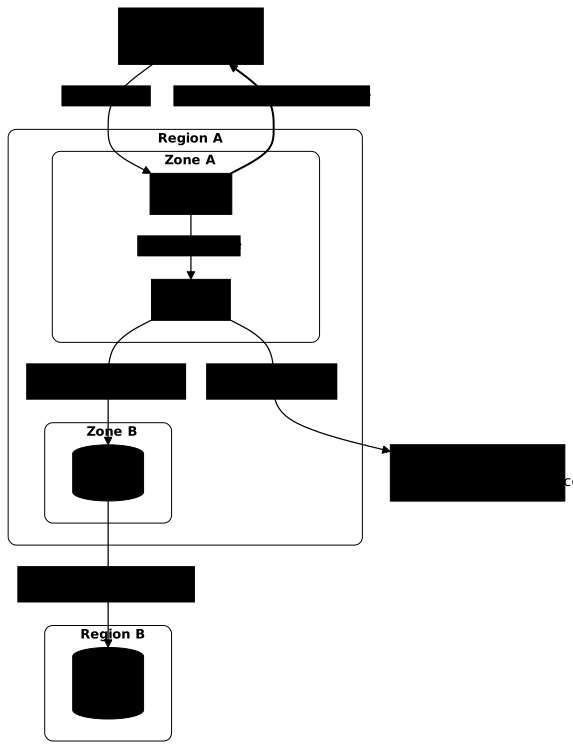
These four zones add up: the same byte can be billed once as cross-AZ between two application tiers placed in different zones, again as cross-region during replication, and a last time on the way out to the user. The detail of each zone follows.
Zone 1, Egress to the Internet: end users loading pages, media downloads, an exposed public API. This is the most visible zone and the one most directly tied to the business.
Zone 2, Cross-AZ egress: traffic between application tiers deployed in different AZs. Frontend in AZ-1a, backend in AZ-1b, DB in AZ-1c, every HTTP call crosses AZs and is billed in each direction at several providers (not at Azure). Invisible in standard dashboards.
Zone 3, Cross-region egress: database replication for DR (disaster recovery: a copy elsewhere to restart if the region goes down), synchronisation of S3 buckets between regions, distribution of containers from a central registry. Remote DR is expensive on an ongoing basis.
Zone 4, Inter-cloud egress: if you mix several providers (for example a hyperscaler for compute, a third-party provider for identity, another for ML services), every call crosses the provider boundary at full rate.
A poorly designed architecture bills in all four zones simultaneously, and the network share of the monthly bill can become disproportionate. A network line that grows faster than the useful traffic is the warning sign of an architecture to review.
5. Five patterns to avoid at all costs
Here are five architectures that often make the egress bill explode. If you recognise one of these situations in your infrastructure, it is money left on the table.
Naive multi-cloud architecture
The trap: frontend at one provider, DB at another, identity at a third, with no peering or grouping strategy.
Symptom: an inter-cloud egress line that weighs heavily in the total bill, unrelated to user traffic.
Mitigation: group the services that talk to each other a lot at the same provider, and set up Direct Connect peering as soon as the monthly saving on transfer (Internet price minus the price on the link, for the same volume) exceeds the fixed cost of the link.
Backup to external storage without optimisation
The trap: a full daily backup exported off-cloud without delta sync (sending only the parts of files modified since the last copy) or compression.
Symptom: 5 TB/month outbound for 50 GB of data actually changed.
Mitigation: delta sync (rclone, restic, borgbackup), compression at the source, an appropriate frequency (hourly delta, monthly full).
Media delivery without a CDN
The trap: a site serving images and videos directly from S3 or Blob Storage, with no CDN in front.
Symptom: egress that scales linearly with visitor traffic, while most of the content is static and cacheable.
Mitigation: a CDN (CloudFront, Front Door, Cloud CDN, Cloudflare) in front of all static assets. With the same provider's CDN as the origin, the gain comes from the per-GB price and the CDN's free allowance: at AWS, CloudFront bills every GB delivered, so the billed volume does not go down. With a third-party CDN in front of object storage that bills its outbound traffic, the gain depends on the cache hit ratio: the more the content is replayed, the less the origin sends.
Continuous cross-region replication for a fake DR
The trap: continuous replication of a database to a secondary region "for DR" when a 24 h RPO (maximum acceptable data loss: one day) would be more than enough.
Symptom: a heavily write-loaded 500 GB database produces about 500 GB of logs per day, that is 15 TB/month of replication and ~300 USD/month in cross-region.
Mitigation: daily incremental snapshots copied asynchronously (only the modified blocks travel), with a 24 h RPO documented and accepted by the business. First measure the volume actually modified per day: if almost the whole database changes every day, the remedy transfers as much as replication, and the saving disappears.
Analytics pipelines sending raw data out
The trap: a pipeline that exports raw logs to an external tool (Datadog, Splunk Cloud, Sumologic) with no filtering or aggregation.
Symptom: 100% of verbose logs leave the cloud, and the third-party tool bills ingestion and the origin cloud bills egress.
Mitigation: filtering by severity before export (no DEBUG outside prod), local aggregation, statistical sampling for verbose logs.
6. Five patterns to favour from the design stage
The mirror image: here are the architectures that structurally reduce egress, without degrading the service.
A CDN in front of all static assets. Images, video, JS/CSS, fonts, everything cacheable should go through a CDN. The CloudFront/Front Door/Cloud CDN rate is generally lower than direct S3/Blob egress (compare on the current grid). Two cases stand out. With the same provider's CDN as the origin, the billed volume stays the same (CloudFront bills every GB delivered, and transfer from an AWS origin is free): the gain comes from the per-GB price and the free allowance. With a third-party CDN in front of object storage that is paid on the way out, the cache reduces the traffic the origin bills, and the gain depends on the cache hit ratio.
Local aggregation and filtering before export. Any data destined for an external tool (monitoring, analytics, backup) should go through an aggregation step in the origin cloud, a volume reduction that depends on the verbosity of the source data. Typical tools: Vector and Fluent Bit for logs, AWS Glue or Spark for analytical batches.
Storage at the same provider as the main compute. Whenever possible, keep data and processing at a single cloud provider. Multi-cloud architectures that look attractive on paper are costly in practice without peering: case 3 gives 6,372 USD per year of transfer between two providers. If the multi-cloud argument is resilience, set up cross-cloud DR for critical data only, not for the whole system.
Peering / Direct Connect beyond the break-even point. If you have a proven need for cross-cloud transit or between the cloud and your own servers, peering becomes worthwhile when the saving made on the monthly transfer exceeds the cost of the port and of the link's commitment; the exact threshold depends on the provider's grid. Do not configure it below that, and calculate it before paying full price above it.
A provider choice consistent with the egress profile. The market shows significant pricing gaps on egress between providers. For an application with very high outbound bandwidth (video, games, streaming, large downloads), comparing the price grids of the different providers before fixing the choice can mean a saving on the TCO (total cost of ownership: everything the service costs over its lifetime, not only the displayed price). This is a case where the egress cost becomes a structuring criterion in choosing a host.
7. Understanding the logic behind egress pricing
To conclude, a look at the economic logic of the egress rates observed on the market.
On the side of providers with high egress, what we observe is a grid where the outbound cost is billed per gigabyte, alongside an extensive range of managed services. Providers do not publish how they build this grid: we can note the effect (a cost for transfers to other platforms), not deduce an intention from it.
On the side of providers with low or included egress, the grid adds no outbound line, and their catalogue of managed services is generally less extensive. It is an observable trade-off: fewer highly specialised services, but a near-zero cost for taking data out.
These two logics coexist on the market and meet different customer needs. For a project with high egress, the egress price grid is among the main criteria for choosing a provider, alongside the maturity of managed services or geographic coverage.
Key points
- Paid egress and free ingress are not a technical asymmetry but a pricing choice. Providers do not publish the reasons; the observable effect is an exit barrier (indirect vendor lock-in).
- The price gap is massive: the hyperscalers bill around 0.09 to 0.12 USD/GB, whereas Outscale (outside Asia) and Scaleway instances add no egress line; object storage follows separate rules (free at OVHcloud, 0.01 EUR/GB beyond 75 GB at Scaleway).
- Four billing zones add up: Internet, cross-AZ, cross-region, inter-cloud.
- Five patterns to avoid: naive multi-cloud, raw backup, delivery without a CDN, needless continuous replication, unfiltered logs sent out.
- Five patterns to favour: systematic CDN, local aggregation, grouping at one provider, peering beyond the break-even point, a provider choice consistent with the workload profile.
- For applications that consume a lot of bandwidth, the choice of provider is an optimisation lever in its own right.
Knowledge check
Check that the essentials of this guide are in place. The questions only cover what has just been explained here.
Knowledge check
Check what you have learned with this interactive quiz
How it works
- The timer starts when you click Start
- Multiple choice, true/false and short answer questions
- You can move between questions
- Detailed results are shown at the end
Starts the quiz and the timer
Review
(0/0)Score by domain
A domain groups several guides and gets several questions, so its score is more reliable than a per-topic score, which often rests on a single question.
Summary
Strengths
No topic passed at 80% on at least two questions yet.
Weak areas
No topic below the pass mark.
Recommended next
Hints before you try again?
Continue the course: Feint: learn, develop and test the cloud without a cloud account
A new full quiz with random questions
Work again only on the questions you missed