Designing a target architecture means choosing between several complete architectures, with criteria written before the scores, then keeping the reason for the choice in an ADR. An ADR (Architecture Decision Record) is a short record that keeps the decision, the options that were ruled out and what would change your mind. This lesson is for the Architect track: every building block of the course already has its own selection grid, and what is left is to assemble them and decide. You start from quantified requirements, set by assumption for the online shop of the final project, lay out three options, rule out the one that misses a requirement, score the other two on six axes, then write the decision.
What you will learn
- Turn a need into quantified requirements, some of which rule out an option before any score.
- Compose complete architecture options that differ on a structural choice and not on a detail.
- Compare the options on security, availability, performance, cost, operability and reversibility.
- Test how robust a score is by changing the weights, and say what the method cannot do.
- Write a decision as an ADR: context, options, criteria, decision, consequences, review condition.
Prerequisites: you have read Well-Architected Frameworks, which names the ADR and the grid of axes, and you know what an RTO and an RPO are (see cloud resilience, in French). The choices by domain (service model, compute, storage, data, sovereignty, cost) are taught in their own lessons: this page assumes you know them and does not repeat the detail. No cloud account or tool is needed, a spreadsheet or a sheet of paper is enough.
Why compare complete architectures rather than building blocks?
An architecture is not a sum of good isolated choices: it is a whole whose parts constrain each other. Picking the best database, the best compute and the best storage one by one can produce a whole that the team cannot operate or that the budget cannot afford. An option is therefore a coherent set of choices, complete enough that you can estimate its bill, its failures and its operating workload.
The selection lessons each answer a local question: the service model, container, function or machine (in French), cloud or alternative (in French), storage (in French), data and failover, sovereignty (in French), cost (in French). Here, the question changes: which assembly meets all the requirements, and why that one rather than another? It is the difference between knowing the parts and drawing the machine.
This lesson stands apart from its two neighbours. The review of the final project (in French) scores your architecture once it is built. The analysis assessment judges an existing architecture that you did not design. Here, nothing exists yet: you compare possible options before spending money, and the written record becomes the starting point of the review that follows.
What requirements must the shop meet?
A useful requirement is a number with an owner, not an adjective. "Highly available" separates nothing; a number such as "99.5% per month" does. The shop of the final project is a three-tier web application (a load balancer, application machines, a database) with a private object storage bucket for product images. The values below are assumptions of the teaching case, not recommended targets: in a real project, they come from the business and the team, never from a provider or a lesson. The 99.5% availability, in particular, is set for the exercise; your shop may demand more or settle for less.
| Requirement | Value set by the case | Role in the decision |
|---|---|---|
| Monthly availability | 99.5% (assumption of the exercise), i.e. 216 minutes of downtime tolerated per 30-day month | knockout |
| RTO, loss of an entire zone | 1 hour | knockout |
| RPO | 15 minutes | knockout |
| Hosting | customer data in the European Union, provider subject only to European law | knockout |
| Budget | infrastructure bill of at most €1,400 excl. tax per month | knockout |
| Load | 300 orders a day on average, peak of 150 requests per second during sales | sizes the options |
| Performance | product page served in under 800 ms for 95% of requests | threshold to meet |
| Volume | 60 GB database (+20 GB per year), 500 GB of images (+100 GB per year) | sizes the options |
| Team | three people, no database administrator, light on-call (response within 30 minutes) | operating constraint |
The downtime budget of the 99.5% assumption is easy to compute: a 30-day month has 43,200 minutes, and 0.5% of 43,200 is 216 minutes. Every outage consumes this downtime budget: a one-hour zone loss already takes 28% of it. The notions of SLA and availability (in French) are taught elsewhere; remember here that an availability requirement and an RTO requirement overlap and must stay consistent with each other.
The table also classifies each line: a knockout criterion is a requirement that no other quality makes up for. The budget and the RTO are knockout criteria, because a brilliant architecture that you cannot pay for or that is down an hour too long is not an option, it is a wish. An operating constraint becomes a knockout criterion as soon as you put a ceiling on it, for example "at most 2 days of operation per month": an option that needs 4 is ruled out, even if its bill is the lowest.
Which architecture options should you compare?
A good comparison sets options against each other that differ on one or two structural decisions, everything else being identical. Here, two decisions structure everything: does the shop live in one zone or two, and is the database managed by the provider or by the team? The foundation (load balancer with a health probe, three-tier network, private image bucket, identities with no long-lived key, backups outside the account) is common to all three options: repeating it would be noise.
| Option A: one zone | Option B: two zones, managed database | Option C: two zones, self-managed database | |
|---|---|---|---|
| Application machines | 2, in zone 1 | 2, one per zone | 2, one per zone |
| Database | one virtual machine, 8 vCPU / 32 GB | managed service 8 vCPU / 32 GB, primary instance and standby instance in the other zone | two 8 vCPU / 32 GB machines, replica in the other zone, promotion driven by the team |
| Backups | database archived every 5 minutes to a bucket outside the zone | the service's backups, plus a logical export outside the account | same as A |
| Image bucket | regional, private | regional, private | regional, private |
| Loss of a zone | rebuild from code and restore the database | automatic failover of the database to the standby instance (expected behaviour of the service, to verify with the provider) | the team promotes the replica and repoints the application |
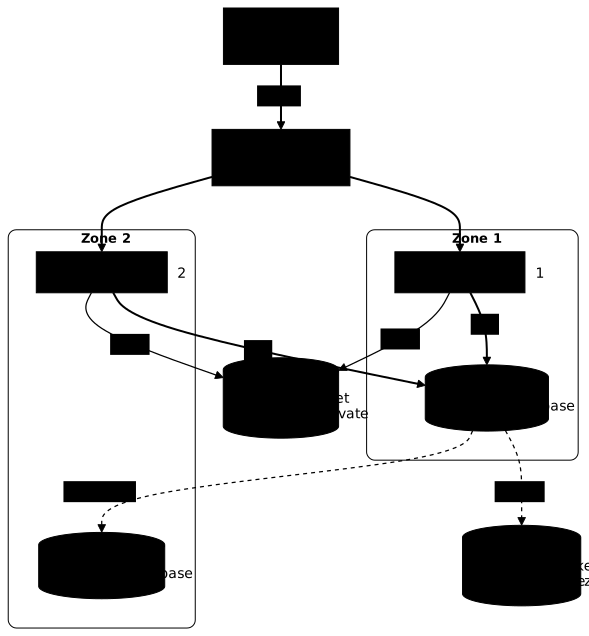
Option A is the one you build by default, because it is the simplest and the cheapest. Option B buys resilience at the price of a managed service. Option C gets it with the same machines as A, at the cost of the team's work. All three are defensible before the calculation, and that is what makes them real options: a comparison in which one competitor is a straw man (an absurd option, there to make the other win) proves nothing.
How do you compare: knockout criteria, then weighting?
The method has five steps, in this order: rule out, weight, score, add up, stress-test. The order matters, because each step guards against a specific bias. Ruling out first prevents a brilliant cost score from making up for a missed RTO. Weighting before scoring prevents adjusting the weights until you land on the winner you already had in mind.
-
Rule out the options that miss a knockout criterion.
Each requirement marked "knockout" gives a yes or no answer, with the estimated value next to it. A ruled-out option is not scored: its comparison stops there, and the reason for ruling it out goes into the ADR.
-
Fix the weights before any score.
Split a fixed total (here 20 points) across the six axes. This split expresses what matters to this organisation, it is decided with the business, and it is published before scoring.
-
Score each axis from 1 to 3, with its basis.
1: acceptable with a clear reservation; 2: good; 3: very good, with no reservation. Each score carries its basis: M for a measurement taken on a prototype, E for a quantified estimate, H for a hypothesis read in a documentation and not verified. A 0 does not exist: an option that fails an axis was already ruled out in the first step.
-
Add up the weighted scores.
The total of each option is the sum of the weights multiplied by the scores. The maximum is 60 here (20 × 3). Also fix beforehand the tie-break rule for ties: the axis with the highest weight on which the options differ.
-
Stress-test the result.
Vary the weights and the fragile assumptions to find from what point the ranking flips. A ranking that flips at the slightest change justifies no firm decision.
The six axes each have a question and a type of evidence, which serve as a grid for any comparison of this kind.
| Axis | The question to ask | Typical evidence |
|---|---|---|
| Security | What can an attacker reach by compromising one component, and who must apply the patches? | flow diagram, split of responsibilities |
| Availability | What happens to the service, and how fast, if a machine, the database or a zone goes down? | failure scenarios quantified as RTO and RPO |
| Performance | Which resource saturates first at the peak, and with what margin? | sizing, load measurement |
| Cost | What bill, and what human work, per month? | dated price list, days of operation |
| Operability | Does the team as it stands know how to run this option, and repair it at 3 a.m.? | list of operating tasks, on-call |
| Reversibility | What does it cost to change your mind or your provider? | exit plan (in French), data format |
The first five axes extend the pillars of the Well-Architected lesson; the sixth comes from the lesson on reversibility. They are deliberately provider-independent: you compare properties, not products.
Which options survive the knockout criteria?
One option out of three is ruled out by the knockout criteria: option A, which misses the RTO. The table gives, for each criterion, the estimated value and the verdict. The thresholds are those set by the case, and all the estimated values are estimates or assumptions of the exercise: you replace them with measurements at the first prototype.
| Knockout criterion | Option A | Option B | Option C |
|---|---|---|---|
| RTO ≤ 1 h, loss of a zone | about 80 min: 30 min to recreate the environment from code (E), 40 min to restore 60 GB (H), 10 min to switch the name (E). Ruled out | about 5 min, automatic failover (H): met | about 50 min: 5 min of detection, 30 min of on-call response, 15 min of promotion and repointing (E). Met, 10 min margin |
| RPO ≤ 15 min | 5 min at most, archiving every 5 minutes (E): met | close to 0 if replication to the standby instance is synchronous (H): met | a few seconds of replication lag (H): met |
| Availability 99.5% (assumption of the case) | a zone loss consumes 37% of the monthly budget (80 / 216): met, but the option is still ruled out by the RTO | 2% (5 / 216): met | 23% (50 / 216): met |
| Hosting in the European Union | identical for all three: same provider, same region | same, but to verify: where is the managed service operated? | identical |
| Product page in under 800 ms (95%), at peak | same sizing for all three: met (E), to measure on a prototype | same | same |
| Budget of €1,400 per month | €568: met | €1,203: met | €873: met |
Two readings are worth making. First, a criterion that separates nobody is checked once, then forgotten: hosting is the same for all three, except one point to read in the provider's terms for option B (some functions of a managed service may be operated elsewhere than the data); that is a verification action, not an advantage. Second, the margin counts as much as the verdict: option C passes the RTO with ten minutes to spare, which assumes the on-call person responds first time, and this fact will go into the availability score and into the ADR.
Which option gets the best weighted score?
Options B and C are scored on the six axes, and B wins with 52 points out of 60 against 38. Before scoring, you need the costs: it is the only axis where the score comes from a calculation, and the only one where the team forgets a line item. The price list below is fictional and simplified (exercise prices in euros excluding tax, including the daily cost of €400 for team time), to be replaced with your provider's dated price list and your internal cost; the logic of the table does not change.
| Item (€ excl. tax per month) | A | B | C |
|---|---|---|---|
| Application machines (2 × 70) | 140 | 140 | 140 |
| Database (machine or service) | 230 | 760 | 460 |
| Database storage | 20 | 60 | 40 |
| Load balancer | 25 | 25 | 25 |
| Internet egress gateways | 35 | 70 | 70 |
| Image bucket | 8 | 8 | 8 |
| Backups | 10 | 20 | 10 |
| Outbound traffic (1 TB) | 60 | 60 | 60 |
| Logs and monitoring | 40 | 40 | 40 |
| Traffic between zones | 0 | 20 | 20 |
| Monthly bill | 568 | 1,203 | 873 |
| Database operating time at €400 per day | ruled out | 0.5 d: 200 | 2 d: 800 |
| Full cost | ruled out | 1,403 | 1,673 |
The €1,400 budget applies to the bill, so option C looks €330 cheaper. But team time is a real cost that the budget does not see, and the "cost" axis must count it: on full cost, C comes to €1,673 against €1,403 for B. The tipping point can be computed: C becomes the cheapest again if running the database takes less than 1.3 days per month ((1,403 − 873) / 400). That is an assumption about the team, and it will be taken up again in the sensitivity test.
The weights, fixed with the business before scoring, total 20 points: security 4 (customer data), availability 4 (the shop lives off its sales), performance 2 (the threshold is already met), cost 3, operability 4 (team of three, no database administrator) and reversibility 3.
| Axis | Weight | Option B (score, basis) | Option C (score, basis) |
|---|---|---|---|
| Security | 4 | 3 (H): no access to the database system, patches and encryption handled by the provider | 2 (E): patches, hardening and disk encryption are the team's job, access to the database machines to protect |
| Availability | 4 | 3 (H): RTO of about 5 min, RPO close to 0 | 2 (E): RTO of about 50 min, 10 min margin, depends on on-call |
| Performance | 2 | 2 (E): same size, tuning limited to what the service exposes, write latency to measure with replication | 3 (E): all settings, asynchronous replication with no write overhead |
| Cost | 3 | 2 (E): full cost of €1,403 | 1 (E): full cost of €1,673, lower bill but heavier work |
| Operability | 4 | 3 (E): backups and failover managed, nothing new to learn | 1 (E): promotion, backups and updates to write, rehearse and run on call |
| Reversibility | 3 | 2 (E): open engine, hence exportable, but failover and backups specific to the service to rebuild elsewhere | 3 (E): everything can be rebuilt from code at another provider |
| Total out of 60 | 20 | 52 | 38 |
The calculation for B: 4×3 + 4×3 + 2×2 + 3×2 + 4×3 + 3×2 = 12 + 12 + 4 + 6 + 12 + 6 = 52. For C: 4×2 + 4×2 + 2×3 + 3×1 + 4×1 + 3×3 = 8 + 8 + 6 + 3 + 4 + 9 = 38. Note that C wins on two axes (performance, reversibility): the total does not say that C is bad, it says that, for this team and these weights, what it brings weighs less than what it costs in work.
How far can you trust this score?
A weighted score organises the discussion, it does not replace judgement. Scores from 1 to 3 are ordinal: "3" is better than "2", without the gap being measurable, and adding ranks gives a total that looks precise without being so. Weights are subjective by nature, and two correlated axes (here availability and operability, which both depend on on-call) partly count the same thing twice.
The remedy is the sensitivity test: look for the point at which the ranking flips, and judge whether that condition is plausible.
- Reversibility. With the other weights unchanged (17 points in total), B is worth 46 + 2w and C is worth 29 + 3w, where w is the weight of reversibility. The two are equal at w = 17: C only comes out ahead if reversibility weighs as much as the other five axes combined. Unlikely here.
- Team. If the team hires a database administrator, C's operability goes from 1 to 3 and the operating time falls to 0.5 day: C's full cost becomes €1,073, and its cost score goes to 3. C rises to 38 + 8 + 6 = 52, like B. The tie-break fixed in advance (the axis with the highest weight on which they differ, security at 4 points) gives B, but the gap has disappeared.
The second test is the most instructive: the decision depends on a fact about the team, not on a technical property. That is precisely what the ADR must write down as a review condition. When a result depends on an assumption H, the right next step is a prototype or a failover test that turns it into a measurement, not an adjusted weight.
There remain cases where the method is not enough: when the options do not differ on an axis that dominates (then a single criterion decides), when the team already knows one of the options and not the others (the familiarity bias weighs in without being written down), or when a decision is irreversible and deserves more than a spreadsheet. In these cases, the table is still useful to expose the disagreement, and a person decides and signs.
How do you write the decision as an ADR?
A well-written ADR fits on one or two pages and answers one question: what are we choosing, from what, by which criteria, and under what condition will we revisit it? The general rules on format, filing in the repository and lifecycle of an ADR are in the guide ADR: keep a trace of your choices. What is specific to an architecture decision comes down to three requirements: the options are described completely enough to be judged again, the criteria are those written before scoring, and the review condition names an observable fact, not an "if things change".
Here is the template, to copy and fill in. It extends the format of Michael Nygard (article of November 2011), which has five fields: title, status, context, decision, consequences. The sections "Options considered", "Criteria" and "Review condition" are additions of this lesson, in the spirit of fuller templates such as MADR. Each section answers a precise question; a section you cannot fill in signals a gap in the preparation, not a flaw in the template.
# ADR-NNNN: <the decision, in one line>
- Status: proposed | accepted | superseded by ADR-NNNN- Date: YYYY-MM-DD- Decision maker: <who decides>, <who validates>
## Context<the need, the quantified requirements, the team's constraints>
## Options considered<option 1: one sentence, what sets it apart><option 2: same>
## CriteriaKnockout: <requirement, value> ...Weighted: <axis, weight> ... (fixed before scoring)
## Decision<the option chosen, and why, citing the criteria>
## ConsequencesPositive: <...>Negative: <what we accept to lose>Accepted risks: <residual risk, measure that reduces it, who accepts it>To verify before going to production: <assumptions H to turn into measurements>
## Review condition<observable fact that reopens the decision>, review before <date>
Here now is the shop's decision, written with this template. It takes up the results of the previous sections without proving them again, and each statement in it points back to a value in the table. Its requirements remain the assumptions of the case: in your own ADR, the context cites the values set by your business, with their source.
# ADR-0007: target architecture of the shop, two zones and managed database
- Status: proposed- Date: 2026-10-12- Decision maker: CTO; the business manager validates the budget
## ContextThe shop (300 orders a day, peak of 150 requests per second) mustmeet the requirements set by the teaching case: 99.5% availabilityper month, an RTO of 1 hour on the loss of a zone, an RPO of 15 minutes,hosting in the European Union and an infrastructure bill ofat most €1,400 excl. tax per month. The team has threepeople, no database administrator, with a light on-call.
## Options consideredA. One zone, self-managed database on a virtual machine.B. Two zones, managed database with a standby instance in the other zone.C. Two zones, self-managed database with a replica and promotion by the team.
## CriteriaKnockout (values of the case): availability 99.5%, RTO 1 h, RPO 15 min,EU hosting, bill of €1,400.Weighted (20 points): security 4, availability 4, operability 4,cost 3, reversibility 3, performance 2.
## DecisionWe choose option B. Option A is ruled out: its estimated RTO of 80 minutesexceeds 1 hour. Between B and C, B totals 52 points out of 60 against 38: ithas the advantage on availability, security and above all operability,at the price of a bill of €1,203 against €873.
## ConsequencesPositive: zone failover expected with no human intervention (assumption,see below), no database for the team to administer.Negative: bill €330 per month higher than C's, dependence on the specificfunctions of the managed service, reversibility scored 2 out of 3.Accepted risks: dependence on the specific functions of the managed service,reduced by a monthly logical export outside the account; accepted by the CTO.To verify before going to production: measured failover time (assumptionof 5 min), actual replication mode of the service (synchronous or not), placeof operation of the managed service, write latency for 95% of requests,replication active, monthly logical export outside the account restored at leastonce.
## Review conditionReopen the decision if a database administrator joins the team(option C then becomes a tie), if the bill exceeds €1,400 per month,if the quarterly failover test measures more than 30 minutes, or if theprovider can no longer guarantee operation of the service in the EuropeanUnion. Review before 2027-10-12.
The test of a good ADR is simple: someone who was not in the room must be able to replay it, find the figures and say what would make it change its mind. The decision is not the most valuable part of the record, it is the review condition: it turns a frozen decision into a dated bet, with its warning signals.
Which mistakes weaken a comparison of options?
Five mistakes come up almost every time, and none depends on the subject. The first is the straw man: an absurd option added to make the one you have already chosen win. The second is the weight adjusted after the fact, when the ranking is unwelcome; the remedy is to publish the weights before scoring. The third is the score without a basis: a "3" that states neither its source nor its degree of certainty (M, E or H) cannot be challenged, so cannot be corrected.
The fourth is the product in place of the criterion: "because this service exists" is not a reason, "because it guarantees a failover with no intervention" is, and that is what makes the decision valid with another provider. The fifth is the ADR with no review condition: a decision that has no expiry date or warning signal becomes a dogma as soon as the team changes.
How do you check that you can do it alone?
Redo the comparison with other requirements: if you find the result below without rereading the tables, you have mastered the method. Take the same three options, but with an RTO of 4 hours and a budget of €700 of bill per month. Which options survive the knockout criteria?
Check your answer: the 4-hour RTO no longer rules out option A (80 minutes), and the €700 budget rules out B (€1,203) and C (€873). Only option A survives, and there is no scoring left to do. The ADR then becomes short, but it keeps its most important section: it must record the accepted risk (a zone loss costs 80 minutes of service) and the condition that would reopen it, for example a revised budget or a zone incident.
To go all the way, then change a single weight of the worked example and look for the value at which the ranking flips. If you can write that value and say whether it is plausible, you can run the comparison for an architecture you have never seen.
Put it into practice
The lab gives the requirements of a customer portal to migrate (data in the EU, three zones, monthly budget, small team) and the measured facts of two complete options. You write a decision.json file: the comparison of the two options on the six axes of the brief, then an ADR that selects one option and records the accepted risk. The validation, which provisions no real cloud, checks that the comparison uses exactly the values of the brief and that the ADR is complete, with its options, criteria, justification, consequences, accepted risk and review condition. It also checks that the selected option meets every mandatory requirement, the operating ceiling included. The axes are those of the brief, compared on measured facts: the weighted scoring seen above is for when the facts do not settle the matter.
Key takeaways
- An option is a coherent set of choices, complete enough to estimate its bill, its failures and its operating workload; two options must differ on one or two structural decisions.
- Requirements are quantified and classified: a knockout criterion (RTO, RPO, budget, hosting) rules out an option before any score, because no quality makes up for a requirement that is not met.
- Weights are fixed before scores, with the business; each score from 1 to 3 carries its basis (measurement, estimate or assumption), and the tie-break rule is written in advance.
- Cost counts the bill and the team's time: an option that is cheaper to host can cost more once operation is priced.
- A weighted score organises the discussion without replacing it: scores are ordinal, weights are subjective, and the sensitivity test says under what condition the ranking flips.
- The ADR keeps the context, options, criteria, decision, consequences and review condition; the latter names an observable fact and a review date.
- The comparison is made without a product or a provider: you judge properties (failover with no intervention, possible exit), not service names.
Knowledge check
Check that you have grasped the essentials of this guide. The questions cover only what has just been explained here.
Knowledge check
Check what you have learned with this interactive quiz
How it works
- The timer starts when you click Start
- Multiple choice, true/false and short answer questions
- You can move between questions
- Detailed results are shown at the end
Starts the quiz and the timer
Review
(0/0)Score by domain
A domain groups several guides and gets several questions, so its score is more reliable than a per-topic score, which often rests on a single question.
Summary
Strengths
No topic passed at 80% on at least two questions yet.
Weak areas
No topic below the pass mark.
Recommended next
Hints before you try again?
Continue the course: Recommend changes: prioritise an action plan
A new full quiz with random questions
Work again only on the questions you missed