This assessment measures one precise skill: evaluating a cloud architecture you did not design, identifying its risks and recommending changes, in writing and in the order in which they matter. It is meant for the Architect track, after the course modules. You receive the brief of a fictional platform, Factoria, described without any provider name, and you hand in a reasoned diagnosis of four pages at most, with prioritised recommendations. The submission is judged by hand, with the rubric published below. No machine marks it, and no model answer is published. The assessment is still a prototype: the site does not receive submissions.
What you will learn
- Map the flows and dependencies of an unknown architecture, including those the diagram does not show.
- Spot the single points of failure and predict what stops when they fail.
- Weigh the trade-offs between security, availability, performance, cost and operability.
- Prioritise recommendations that can be verified and do not depend on a provider.
- Present all of it in a document that a decision-maker reads in ten minutes.
What prerequisites do you need before starting?
You must have studied the network, data, identity, exposure, operations and governance modules of the course, and know the review method described in the lesson Well-Architected Frameworks. That lesson provides the review logic by axis, the 0-to-3 scores and the principle that a score rests on evidence, which you will reuse here: an axis with no evidence behind it scores 0. The notions of availability, RTO and RPO come from the lesson Cloud resilience (in French).
The assessment also measures how you read an unknown architecture, which is taught by the Services Architecture course (in French). You need at least the lesson Reading an architecture (in French), which teaches you to list the building blocks, flows, state and dependencies, the lesson Dependencies, SPOFs and failure domains (in French), which teaches you to predict what stops when a single point fails, and the Operations checkpoint (in French), which exercises recovery and administration access. The Factoria case also touches identity, secrets and backup, covered by Identity and authorisation (in French) and Keeping data: backup, restore and DRP (in French). These lessons teach you to read and predict. The skill of recommending and prioritising is taught by the lesson Recommending changes, to be followed just before the assessment: without it, criteria C6 and C7 of the rubric would measure a skill you had not learned.
The assessment does not repeat three similar exercises. The lesson Designing a target architecture has you compare possible options and decide before building: nothing exists yet. The final project (in French) has you build an architecture and then score your own. The capstone of the Services Architecture course (in French) has you read an architecture to recognise its building blocks and predict failures. Here, you judge a foreign architecture without having built it, and you must recommend: this is the job of the architect called in to help on an existing system.
How does the assessment run?
Plan three hours in one sitting: thirty minutes of reading, ninety minutes of analysis and one hour of writing. You need no cloud account and no tool, only the brief, your course notes and a word processor. You may consult a provider's documentation, but your criteria and recommendations must remain valid with any provider.
The submission is judged by hand, using the rubric in the section "Which rubric scores the submission?". There is no automatic marking: no quiz and no script scores a diagnosis, because two good architects can defend two different priorities with valid arguments. Have your submission reviewed by a person who knows the field and has read the rubric (mentor, architect colleague or peer), or score it yourself with the rubric to practise.
The brief: what is Factoria made of?
Factoria is an online invoicing service for small businesses: 1,800 client companies, 6,000 users, about 2 million invoices issued per year. Clients create their invoices in a web application, download them as PDF, trigger reminders by email and collect payment on some invoices through an online payment provider. The team has six people: four developers, one part-time administrator and the CTO. The service runs in a single region of a cloud provider that the brief does not name: read the components by their family (virtual machine, object storage, load balancer, database), as you would in front of a client whose provider you do not know.
The table lists each component. Together with the survey that follows, it is the only source of truth: the diagram summarises it, and a statement that appears in neither the table nor the survey is an assumption that you must flag as such.
| Component | Role | Noted particulars |
|---|---|---|
| Managed load balancer | Receives HTTPS traffic, terminates TLS | Certificate bought and installed by hand, expires in January, reminder in the CTO's calendar |
| Application, 2 machines | Serves the interface and the API | Two identical machines, 55% CPU at the month-end peak, 18% the rest of the time |
| Batch machine, 1 machine | Generates the PDFs overnight and sends the reminders | 16 virtual CPUs, on 24 hours a day, works about 2 hours a night and up to 6 hours at month end |
| Database, 1 instance | Stores clients, invoices, users | Installed on a virtual machine, 8 CPUs, 2 TB of disk, no replica |
| PDF bucket | Stores issued invoices (6 TB, +1.5 TB per year) | "Hot" storage class, no versioning, no copy |
| Backup bucket | Receives the nightly database backup | In the same account and region as production |
| Bastion host | Administration entry point | One machine reachable over SSH |
| Repository and pipeline | Builds and deploys the application | Hosted continuous integration service |
| Email provider | Sends invoices and reminders | External service, called over HTTPS |
| Payment provider | Collects payment on invoices | External service, called over HTTPS |
| DNS | Resolves the domain name | Zone and domain at a registrar, account in the CTO's name |
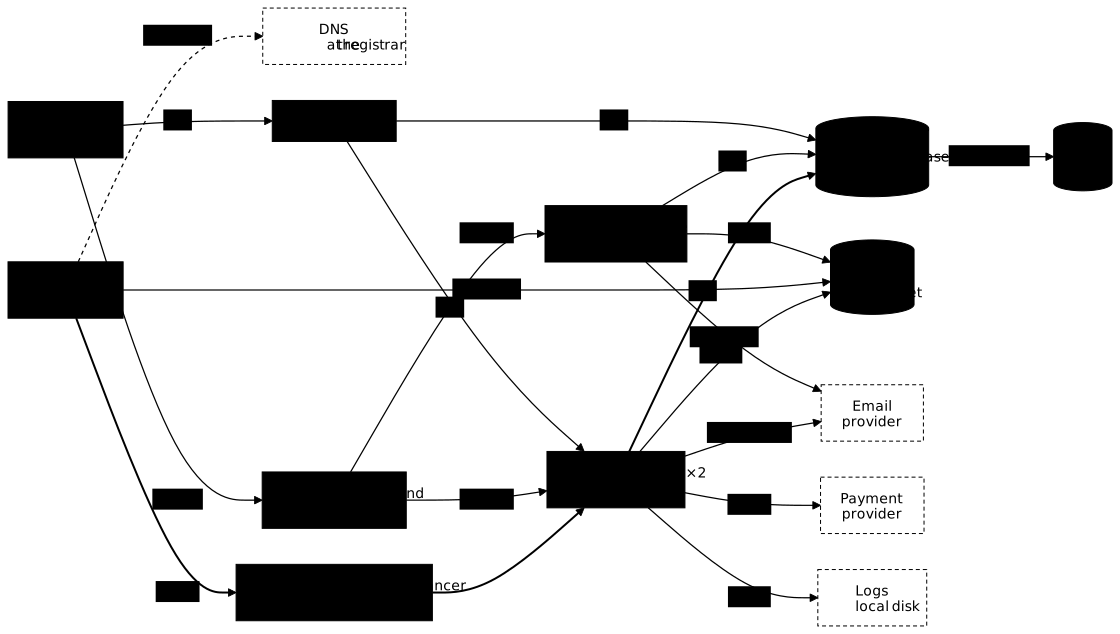
The diagram follows a client's request: the thick line goes from the browser to the load balancer, to the application, then to the database. The thin lines are the side flows: PDF storage, calls to the providers, the nightly copy, deployment and administration. Read it together with the text, never alone: the diagram does not say where the secrets are, who can administer what, or what is logged.
Which flows and commitments do you need to know?
Four flows carry the service: invoice creation, PDF download, the nightly job and administration. Here they are, in the order the team describes them.
-
Invoice creation. The client sends the invoice to the application, which writes it to the database, then calls the email provider within the same request to send the notification. The request is only complete once the provider has answered.
-
PDF download. The application returns to the client a direct link to the PDF bucket. The objects in the bucket are readable by anyone who knows their address, which contains a random identifier of twelve characters.
-
Nightly job. At 2:00, the batch machine reads the day's invoices from the database, generates the PDFs in the bucket, then sends the reminders through the email provider. If the job fails, nobody is notified before the next morning.
-
Administration. The team's seven accounts connect over SSH to the bastion host, then to the machines and the database. Deployment starts from the pipeline on every merge to the main branch.
Factoria has made contractual commitments to its clients, which you must compare with what the architecture really allows.
| Commitment | Value |
|---|---|
| Monthly availability | 99.9% |
| RPO (maximum acceptable data loss) | 4 hours |
| RTO (maximum recovery time) | 4 hours |
| Retention of issued invoices | 10 years |
| Data hosting | European Union |
| Invoice creation time | under 3 seconds for 95% of requests (measured: 1.8 s off-peak, 6 s at the month-end peak) |
What does the survey of the current state reveal?
The following survey was drawn up by the administrator, as is, without interpretation. It describes what the team observed in October. Each line is a fact from the brief: it is up to you to decide which ones matter, which are harmless and which hide others.
| Theme | Survey |
|---|---|
| Human identities | Seven accounts local to the cloud: six employees and a development contractor whose engagement ended in March. All of them hold the administrator role. Two-factor authentication is enabled on three accounts out of seven. The contractor's account last signed in in April. |
| Secrets | A service account, svc-factoria, has an access key created 31 months ago, never rotated, with administration rights on object storage. This key and the database password are in an environment file on each machine and in the pipeline variables. |
| Deployment | Any developer who merges to the main branch triggers a production deployment. The pipeline uses the rights of an administrator account. |
| Environments | Development, staging and production live in the same cloud account, told apart by labels. |
| Network | One private network, a public subnet (load balancer, bastion host, Internet egress) and a private subnet (application, batch, database), both in zone A. The bastion host accepts SSH from any address, with a key shared by the team. The database accepts all connections from the private subnet, without encrypting the link. |
| Data and backups | Logical export of the database every night at 2:00, lasting 25 minutes, copied to the backup bucket with the same credentials as production, kept for 14 days. The restore has never been rehearsed. |
| Logs | The platform audit log is active with the provider's default short retention, with no export. Application logs are files on each machine's disk, rotated at 7 days. Load balancer logs are disabled. |
| Monitoring | An external availability probe queries the home page every 5 minutes and writes to a shared mailbox. No other alert. |
| History | No major incident reported in twelve months. Two slowdowns at month end. |
| Management | The CEO asks to cut the hosting bill by 15% before the end of the half-year. |
The monthly infrastructure bill, in euros excluding tax (fictional figures provided for the exercise), breaks down as follows.
| Item | Monthly amount |
|---|---|
| Application machines (2) | 620 |
| Batch machine | 1,150 |
| Database (machine and disk) | 980 |
| PDF object storage | 120 |
| Backup storage | 60 |
| Load balancer | 45 |
| Internet egress gateway and outbound traffic | 310 |
| Bastion host | 25 |
| Email provider | 250 |
| Hosted continuous integration | 90 |
| Total | 3,650 |
A 15% reduction amounts to about 550 euros per month. This line of the survey is neither an instruction to carry out nor a trap: it is a business constraint that your analysis must take into account.
What is the task?
You are called in by the CTO, who wants to know whether Factoria can meet its commitments and what to fix first. You have no access to production and no way to ask questions: missing information becomes assumptions that you write down. Your mission comes down to five steps, to be done in this order.
-
Map: describe the flows and dependencies of Factoria, including those that the brief only shows indirectly (who depends on what, what depends on it, and what is done by hand).
-
Look for single points of failure: for each one, say what stops, for how long, and whether the contractual commitment still holds.
-
Analyse the trade-offs: for at least three trade-offs the team made (knowingly or not), say what is gained, what is given up and whether you would defend them. The five axes are security, availability, performance, cost and operability (the team's ability to run, monitor and repair the system).
-
Prioritise: order your findings and recommendations, justifying the order by severity, likelihood and effort.
-
Recommend: each recommendation is a verifiable action, with its expected effect, its cost and its residual risk.
Keep three working rules. Base every finding on an element of the brief, quoted. Separate fact from assumption: "the database has no replica" is a fact, "failover would take a day" is an estimate to justify. Put numbers on things whenever the brief allows it, for example the monthly downtime that a 99.9% commitment permits.
What deliverable should you hand in, and in what form?
The deliverable is a reasoned diagnosis followed by prioritised recommendations, in four pages at most, following the template below. The template fixes the order of the sections, not their length: a short summary, sourced findings, then ranked recommendations. A reader in a hurry must find the essentials in the first section without reading the rest.
# Diagnosis of the Factoria architecture
## 1. Summary for management (ten lines at most)- Your verdict: does Factoria meet its commitments? Why?- The three risks that matter most.- The three actions to start first.- What you advise against doing.
## 2. Assumptions and missing information- What you had to assume, and how you would verify it.
## 3. Map- Main and side flows.- Dependencies (internal, external, human).- Single points of failure: component, effect of the failure, probable  duration, commitment affected.
## 4. Findings| No. | Finding | Evidence in the brief | Axes affected | Severity | Likelihood ||---|---|---|---|---|---|
## 5. Trade-offs analysed (at least three)| Trade-off | What is gained | What is given up | Your decision and its reason ||---|---|---|---|
## 6. Prioritised recommendations| Rank | Action | Findings addressed | Expected effect | Effort and cost | Residual risk | Depends on ||---|---|---|---|---|---|---|
## 7. What this diagnosis cannot judge- Limits of the analysis, and what would need to be measured to decide.
A provider-independent recommendation describes the result to achieve and the criterion to verify it, not a product. "Backups are restored every month in an isolated environment, with the time measured" can be verified with every provider, whereas the name of a particular service does not transfer. You may cite a mechanism (identity attached to the machine, short-lived token, locked object) as long as you say which property it provides.
Which rubric scores the submission?
The rubric has eight criteria, each scored from 0 to 3, unweighted, for a total of 24 points. This is version 2 of 12 October 2026, which replaces a first, weighted version: every criterion counts as much as the others, and the knockout criteria say what cannot be made up for. It has not yet been calibrated on real submissions: the criteria and the threshold are a starting reference. Any change produces a new dated version, and a submission is judged with the version in force on the day it is handed in. The criteria do not depend on any provider: they judge the quality of the reasoning and of the presentation, not knowledge of a product.
A list of reference findings exists for the assessor; it is not published so that the assessment stays a measurement. Without it, the assessor judges coverage from the brief. In both cases, they accept any additional finding that is well supported: the list does not impose a single answer.
| Criterion | 0 | 1 | 2 | 3 |
|---|---|---|---|---|
| C1. Faithful reading of flows and dependencies | Map missing or contradicted by the brief | Main flows correct, external or human dependencies ignored | Flows and dependencies correct, including external and manual ones, with one minor error or omission | Exact and complete map, hidden dependencies included, with nothing invented |
| C2. Risk identification | Fewer than three real risks identified | Real risks on only one or two axes | Real risks on at least four of the five axes, with one major risk missed | Major risks identified on all five axes, or a gap explicitly justified |
| C3. Single points of failure | No single point identified | Points cited without failure effect | Points identified with failure effect, without comparison to the commitments | Points identified with effect, probable duration and affected contractual commitment, with numbers |
| C4. Trade-off analysis | No trade-off analysed | Trade-offs named without both sides | At least three trade-offs with gain and sacrifice, decision poorly justified | At least three trade-offs with gain, sacrifice, decision criterion and defensible decision, including the cost constraint |
| C5. Argument from evidence | Claims with no support | Findings supported for fewer than half | Findings supported by the brief, fact and assumption sometimes confused | Every finding cited to the brief, assumptions declared, figures justified. A claim contradicted by the brief caps this criterion at 1 |
| C6. Prioritisation | List with no order | Order without justification | Order justified by severity only | Order justified by severity, likelihood and effort, separating quick wins from structural projects, dependencies between actions made explicit |
| C7. Actionable recommendations | Vague or product-specific recommendations | Clear actions with no verification criterion | Verifiable actions with expected effect, cost or residual risk missing | Every action verifiable, with effect, effort and cost, residual risk, and provider-independent |
| C8. Quality of presentation | Template ignored or more than six pages | Template partly followed | Template followed, summary too long or confused | Template followed, four pages at most, summary that a non-technical decision-maker understands alone |
The pass mark is 18 points out of 24 (75%), provided you score at least 2 on the knockout criteria C2, C5 and C6. No minimum score is required on the other five criteria: a 0 on C8 can be made up by the total, a 1 on C2 can never be made up. A submission that is brilliant in its presentation but misses the essentials (C2), proves nothing (C5) or cannot order its points (C6) does not pass, whatever its total. The expected verdict is "passed" or "to be redone", with a comment per criterion.
This rubric reduces the share of judgement without removing it. The assessor looks for observations, for example "the submission cites the line of the brief that proves the finding", not a general impression. If you assess a submission, have it read by two people and discuss any gap in total greater than two points, as well as any disagreement on a knockout criterion. Two points out of 24 make a little under a tenth of the score: beyond that, the gap alone can put the two totals on either side of the threshold, and change the verdict. Since the brief is public, a retake no longer measures exactly the same thing: the assessor may ask you to defend the submission orally, or propose another architecture.
Which presentation mistakes come up most often?
Four mistakes cost the most points, and none depends on the subject. The first is the unordered list: twenty findings lined up with no rank help nobody decide. The second is the maximalist recommendation, for example "rebuild everything across several regions", which ignores the cost and the capacity of a team of six. The third is the product in place of the criterion: citing a specific service without saying which property you are after. The fourth is the finding without evidence, which mixes what the brief says with what you imagine of the architecture.
A good habit is to reread each recommendation with the CTO's question: "what do I do on Monday morning, how much does it cost, and how will I know it works?" If your text does not answer those three questions, the recommendation is not finished.
Key takeaways
- The assessment judges an architecture you did not build: you map it, look for single points of failure, weigh trade-offs, then recommend.
- The deliverable is a reasoned diagnosis of four pages at most, with prioritised recommendations, following the template provided.
- Every finding rests on the brief, and every assumption is declared as such.
- Recommendations describe a result and its verification criterion, never a provider's product.
- The submission is judged by hand with the version 2 rubric, unweighted and not yet calibrated: eight criteria scored from 0 to 3, 18 points out of 24, with at least 2 on the knockout criteria C2, C5 and C6. No automatic marking exists and no model answer is published.
- The assessment is a prototype, with no submission mechanism: a review by a mentor, a peer or yourself is not authenticated and does not complete the mission in your path on the site.